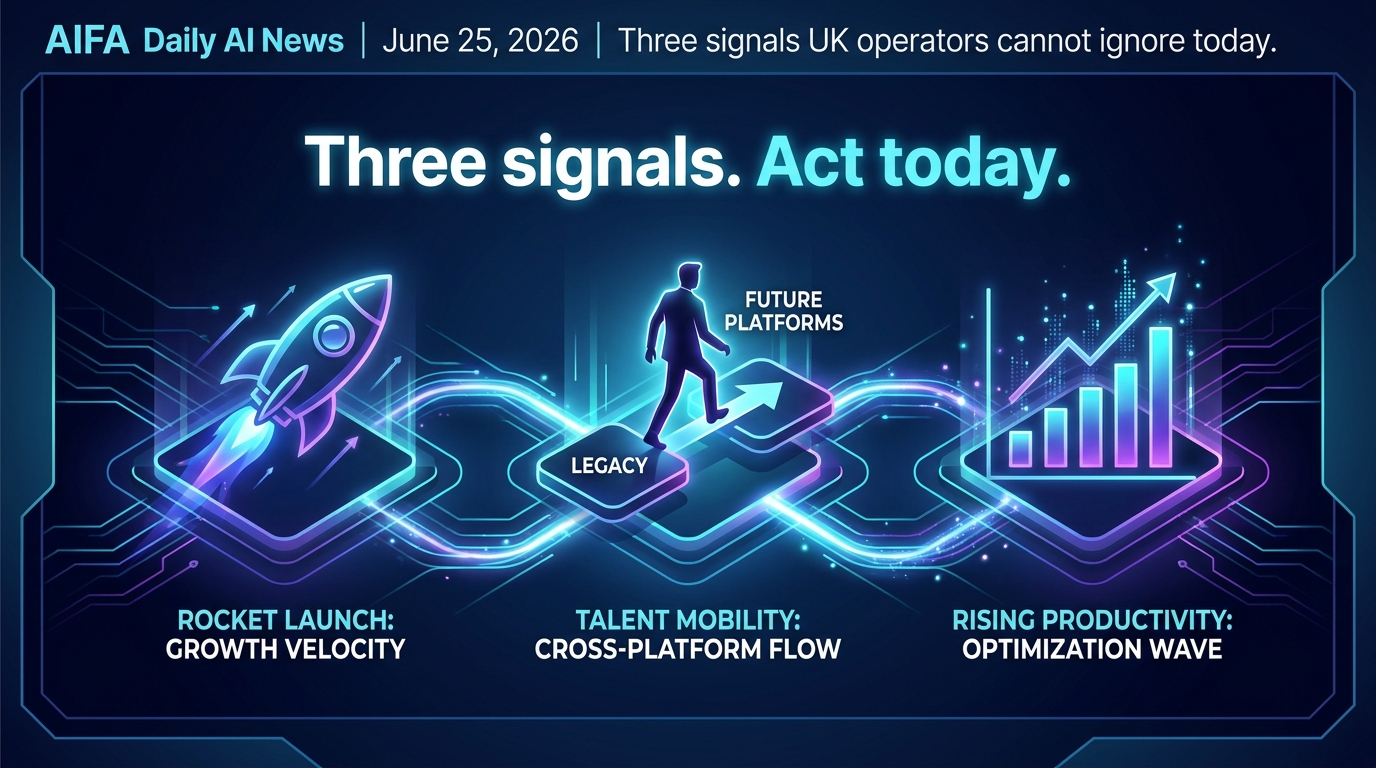
Why this day matters: Most single news days offer one development worth tracking. Today delivered four — simultaneously. A model launch, a talent exodus, a market maturity report, and a ticking deadline. Taken separately, each is interesting. Taken together, they tell a coherent story about where UK businesses stand with AI right now, and what to do about it.
Signal 1: GPT-5.6 is live today — and it changes the entry price
OpenAI released GPT-5.6 on 25 June. The headline figures: 1.5-million-token context window, the "Kindle bug" agent alignment fix, and pricing approximately one third of GPT-5.5. This is not a minor update — it is a meaningful capability step at a substantially lower cost.
For UK businesses, GPT-5.6's launch today has a specific practical implication: if you were evaluating GPT-5.5 and the cost was a barrier, that barrier has fallen. At roughly one third of the previous price, extended document processing, complex reasoning tasks, and multi-step automation workflows that were cost-prohibitive last week are now worth running the numbers on again.
GPT-5.6 should be on your test list this week — not next month. It is available now, the pricing is the lowest OpenAI has offered at this capability tier, and the Kindle bug fix means it can run longer multi-step tasks without the alignment drift that plagued GPT-5.5 in production. Run your hardest document processing task through it today and compare to your current model.
Signal 2: Four Google researchers in six days — this is not routine
Jonas Adler, Alexander Pritzel, John Jumper (Nobel laureate), and Noam Shazeer (transformer co-inventor) have all left Google for Anthropic in the same six-day window. These are not support roles — these are the people whose names appear on the papers that underpin modern AI. The concentration of that calibre of researcher moving to a single company in a single week is statistically unusual.
The IPO incentive explains some of it. Anthropic is approaching a public listing; pre-IPO equity is financially compelling in a way established companies cannot match. But financial incentive alone does not explain the mission alignment factor: Anthropic was founded by researchers who left OpenAI over alignment concerns, and the concentration of safety-focused frontier researchers there is now becoming very visible.
For short-term platform decisions — the task you need AI to help with this week — use whichever tool gives the best output for your specific use case. Today, all three frontier platforms (Claude, ChatGPT, Gemini) are genuinely capable. The talent signal matters for multi-year enterprise decisions, not for which tool you open on Monday morning. If you are evaluating a two-to-three year AI partnership with a single vendor, weight the talent direction of travel in your assessment. Anthropic and OpenAI are the net importers.
Signal 3: The AWS report — you are probably in the 76%
The AWS UK AI maturity report released this week contains the most important number in today's briefing: only 24% of UK organisations have reached advanced AI use — defined as AI integrated into core business processes. The other 76% use AI occasionally, for single tasks, without measurement, without consistency. The efficiency gap between those two groups is 28 percentage points: advanced users report 68% efficiency gains versus 40% for basic users.
That 28-point gap is not explained by which tools organisations use. It is almost entirely explained by how consistently they use them. A business that runs AI through the same workflow every day compounds its efficiency gains. A business that uses AI when it remembers to does not.
If you are reading this briefing and you do not have a single workflow — one recurring task, same process, every time — where AI is a consistent part of the operation, you are in the 76%. The path out is not buying a new tool. It is committing to one workflow and measuring it. Choose one: customer enquiry responses, quote generation, meeting notes summary, invoice drafts. Make it consistent for four weeks. Track time saved. That is the move from 40% to 68% — not a new subscription.
Signal 4: Five days on the Gemini clock — don't let it stall your decisions
Gemini 3.5 Pro has a June 30 general availability target and prediction markets at 50–55% odds. That is a coin flip. The relevant point for UK businesses is not whether Gemini 3.5 Pro launches on time — it is that the five-day window should not stall decisions that do not depend on it. If you are building a workflow on Google Workspace tools you already use, the case for Gemini is the native integration, not the benchmark numbers. If you are evaluating a platform from scratch, the integration advantage is still real whether Gemini 3.5 Pro lands on June 30 or July 14.
Write your Gemini 3.5 Pro test case today — your hardest task, your quality standard. Have it ready to run the moment it becomes generally available. Do not extend any vendor contracts this week waiting for a launch that is 50/50. Continue with your current tools. Evaluate what actually ships against your prepared benchmark, not against the announcement.
The coherent story behind all four signals
These four signals are not independent. They are all manifestations of the same underlying dynamic in mid-2026: AI capability is now genuinely strong across all three frontier platforms, the cost of accessing that capability has dropped dramatically (GPT-5.6 at one third the price), and the primary differentiator for UK businesses is no longer which model they use — it is whether they use any model consistently.
The talent exodus from Google to Anthropic tells you where the research frontier is concentrating. GPT-5.6's pricing tells you the cost floor has dropped again. The AWS maturity data tells you most UK businesses are not using what already exists effectively. The Gemini deadline tells you not to wait for perfection before building your current workflows.
They did not wait for the perfect model. They did not evaluate three platforms for six months. They picked one workflow, ran AI through it consistently, measured the outcome, and then expanded to a second workflow. The tools they are using today — Claude, ChatGPT, Gemini, or custom deployments — are tools that existed twelve months ago. The gap between 40% and 68% efficiency is not a technology gap. It is a commitment gap. Today's news gives you better tools at lower cost than those businesses had when they made that commitment. The remaining ingredient is intention.
What to do this week
AIFA operator brief — week of 25 June 2026
Today (GPT-5.6): If you have a complex document processing or reasoning task that felt too expensive with GPT-5.5, run it through GPT-5.6. Use the 30-minute evaluation guide in our GPT-5.6 article — input/output sample, three-task comparison, cost estimation.
This week (talent signal): No platform changes needed based on research moves alone. If you are in a multi-year enterprise contract evaluation, weight Anthropic and OpenAI more heavily in long-term projections. For immediate task work, use what works best for your use case today.
This month (AWS gap): Name one recurring workflow. Commit to AI-assisted every single time for four weeks. Measure time saved after two weeks. If you have not done this yet, this is the highest-value action in this entire briefing.
By 1 July (Gemini): Set a calendar alert. Prepare your test case. Do not delay other platform decisions waiting for a 50/50 launch. Check the Gemini countdown article for the full evaluation framework.
The AI landscape for UK small businesses in June 2026 is better than it has ever been — better tools, lower prices, deeper integrations. The constraint is no longer access. It is the decision to use what is already available, consistently, in a process that compounds over time. Today's four signals all point at the same action: stop evaluating and start measuring.