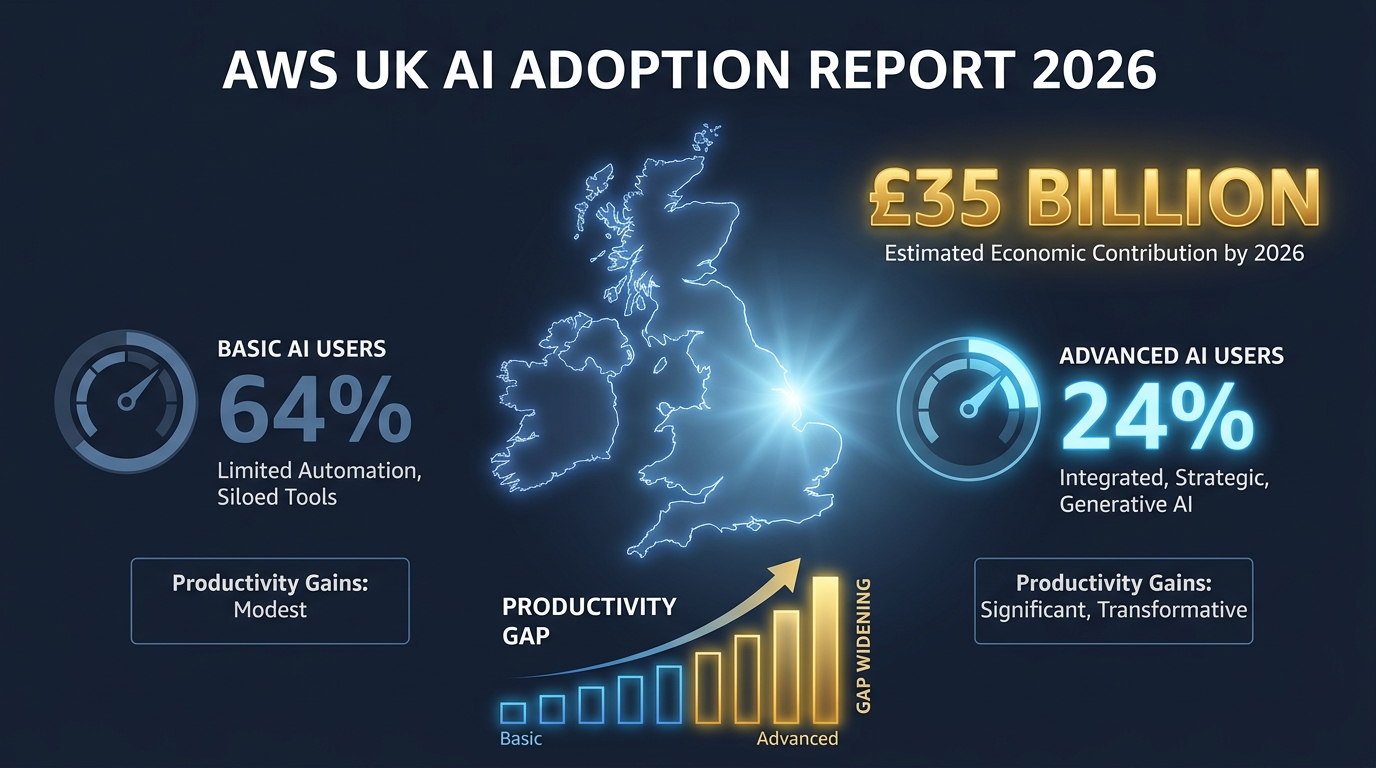
The finding in one sentence: Most UK organisations are now using AI for occasional tasks — but the vast majority are leaving significant efficiency gains, and a collective £35 billion in economic output, on the table by not integrating AI into their core processes.
What the AWS report actually found
AWS surveyed organisations across the UK to assess AI maturity at three levels: those not yet using AI, those using it for basic tasks, and those who have integrated AI into core business processes and decision-making. The key figures:
- 64% of UK organisations now use AI — up from 52% a year ago. If you include businesses using AI-adjacent tools without specifically classifying them as AI, the number is almost certainly higher.
- Only 24% have reached "advanced" AI status — defined as AI integrated into core business processes and decision-making. This has barely moved from last year's 23%.
- Advanced users report 68% average efficiency gains, compared to 40% for basic users. That is a 28-percentage-point difference in measurable efficiency — from the same tools, just deployed differently.
- 49% of organisations cite digital skills gaps as the primary barrier to advancing from basic to advanced AI use — up from 46% last year.
- The gap is estimated to be worth £35 billion in additional UK economic output by 2030, equivalent to the entire economy of Manchester.
What "basic" versus "advanced" actually means
The gap between 40% and 68% efficiency gains is not explained by which AI tools an organisation uses. It is explained by how they use them. Basic AI use looks like this:
- Asking an AI assistant to summarise an email or write a first draft.
- Using an AI chatbot to answer FAQ queries from customers.
- Generating social media content with an AI tool once a week.
Advanced AI use looks like this:
- AI integrated into the daily workflow of sales, operations, or admin — not as an occasional tool but as a consistent layer in the process.
- Measurable outcomes tracked: time saved per task, error rates, response times, conversion rates.
- AI assisting in business decisions — routing, prioritisation, anomaly detection — not just content generation.
The 40% efficiency gain for basic AI users is real — but it is the ceiling of inconsistent, task-by-task AI use. Once you use AI to write a document, the next task you do without AI produces nothing. Advanced AI use compounds: it builds AI into recurring processes, so the efficiency gain accrues every time the process runs. The difference between 40% and 68% is not capability — it is deployment consistency.
What this means for UK service businesses specifically
The AWS report covers all UK organisations — large enterprises, mid-market companies, and SMBs. For a small service business, the path from basic to advanced AI use is actually shorter than it is for a large enterprise, because there are fewer processes, fewer stakeholders, and a faster decision cycle.
A small service business moving from basic to advanced AI use typically means committing to three things:
- One repeating workflow fully AI-assisted: Not occasionally, every time. Customer enquiry responses, quote generation, booking confirmations, invoice drafts — pick one and make AI a consistent part of it.
- A measurement habit: Track time saved, errors caught, tasks completed faster. Without measurement, you cannot tell if you are at 40% or 68% — and you have no signal for where to improve next.
- A skills investment: The biggest barrier the AWS report identifies is skills gaps. For a small business, this means the owner or one team member becoming genuinely competent with an AI tool — not just occasionally using it.
The £35 billion figure: context for small businesses
£35 billion is a national number. For a small business, the prize is proportionally smaller but structurally identical: the difference between AI as an occasional helper and AI as a consistent part of your operations is a compounding efficiency gain that shows up in hours saved, admin costs reduced, and customer response times improved.
The 24% of UK organisations that have reached advanced AI use are not primarily large corporations with technology budgets. They include owner-operated businesses and small teams who made a decision to integrate AI properly rather than use it sporadically. The primary ingredient is not budget — it is intention.
What to do this week
Operator action: close the gap
If you are in the 36% not yet using AI: Start with one text-based task today. Admin is the most common entry point: drafting an email reply, summarising meeting notes, writing an FAQ answer. Use it three times this week.
If you are in the 40% using AI for basic tasks: Name one recurring workflow — something you or your team does every day or every week. Commit to making AI a consistent part of that workflow for the next four weeks. Measure the time saved after two weeks.
If you are already in the 24% advanced: Use this report as a benchmark check. Are you measuring outcomes? Are you expanding to a second workflow? The path from 24% to 30% is the same principle applied to a new process.
The £35 billion productivity prize is not reserved for large corporations. It is distributed across every UK business that moves from occasional AI use to consistent AI integration. The tools exist. The cost is accessible. The remaining barrier, as the AWS report confirms, is skills and intention — both of which are within a business owner's control.