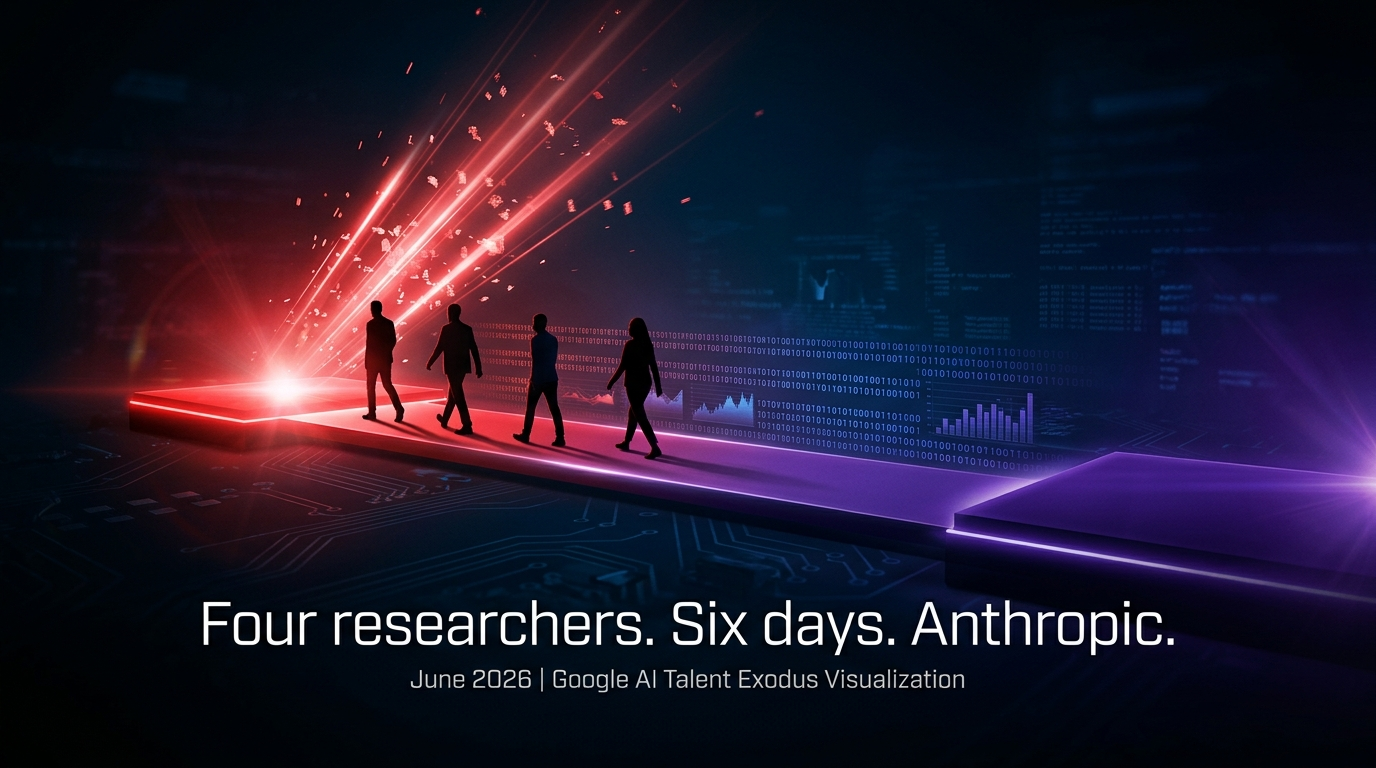
What happened: Bloomberg reported on 24 June 2026 that Jonas Adler (Google's AI coding lead) and Alexander Pritzel (AI training specialist) are planning to leave Google for Anthropic. This follows the departure of Nobel Prize winner John Jumper and researcher Noam Shazeer to Anthropic in the same week. Four senior researchers. Six days. All moving to the maker of Claude.
Who these researchers are and why it matters
This is not a routine talent reshuffle. Each of these four individuals was working at the frontier of Google's AI research:
- John Jumper — Nobel laureate, co-creator of AlphaFold 2, Google DeepMind's most cited researcher. AlphaFold's protein-folding breakthrough is one of the most consequential scientific achievements of the decade.
- Jonas Adler — key contributor to Google's AI coding efforts, worked with Jumper on protein-folding research.
- Alexander Pritzel — AI training specialist at DeepMind / Gemini, involved in core model training pipelines.
- Noam Shazeer — co-inventor of the transformer architecture, one of the most foundational researchers in the history of modern AI.
These are not mid-level hires. They are the researchers whose names appear on the foundational papers that underpin the tools you use today.
Why talent moves to Anthropic specifically
The IPO incentive is real: Anthropic is on the cusp of a public listing, and joining before an IPO offers pre-IPO equity that can represent life-changing financial returns for senior researchers. Google, Microsoft, and Meta can match salaries — they cannot easily match the IPO upside of a pre-public company at Anthropic's current scale.
But the financial incentive alone does not explain four departures in six days. There is also a mission alignment factor. Anthropic was founded by former OpenAI researchers explicitly concerned with AI safety and alignment. For researchers at Google who work on the hardest unsolved problems in AI — training stability, alignment, agent reliability — Anthropic's research culture and mission are a compelling pull that salary alone cannot compete with.
AI research talent is concentrating at two companies: Anthropic and OpenAI. Google, Meta, and Microsoft are net exporters of frontier talent to these two. This does not mean Google's models will deteriorate immediately — organisations with Google's resources can recruit and retain substantial talent. But the direction of travel — where the best researchers choose to work when they have a choice — is a leading indicator of where frontier capability will be two to three years from now.
What this means for UK businesses choosing AI platforms
If you are currently evaluating which AI platform to build your business workflows on, the talent war has a practical implication: the organisations that are attracting the best researchers today are likely to ship the strongest models in the next 24–36 months.
This does not mean abandoning Google tools. Gemini is deeply integrated into Google Workspace — Docs, Gmail, Meet, Drive — and for UK businesses already on Google Workspace, that integration value is real and immediate. The talent signal is a long-term indicator, not a short-term recommendation to switch tomorrow.
The AI landscape for UK businesses in 2026 has three credible frontier platforms: Claude (Anthropic), ChatGPT / GPT-5.6 (OpenAI), and Gemini (Google). All three are capable of handling everyday business tasks. Where they differ is trajectory. Anthropic and OpenAI are attracting frontier research talent. Google has enormous infrastructure, deep product integration, and significant in-house talent — but is currently a net exporter at the researcher level. Build your platform decisions around current capability for current tasks, and monitor the talent signal as a leading indicator of where capability will be strongest in 2028 and beyond.
Practical advice for UK businesses
Avoid over-rotating on talent news. A researcher leaving Google does not break Google's existing models. Gemini 1.5 Pro, Gemini 2.0, and their successors remain strong tools for practical business tasks today.
The signal is relevant for a specific decision: if you are about to commit to a multi-year enterprise agreement with a specific AI platform, and the talent trend lines matter to you, weight Anthropic and OpenAI more heavily in your long-term evaluation. For short-term task automation — summarising documents, generating first drafts, answering customer queries — use whichever platform your team already knows and integrates cleanly with your existing tools.
What to do
Operator action
Current Google Workspace users: No action needed today. Gemini integration with your existing Google tools is still real and valuable. Monitor Gemini releases quarterly.
Evaluating platforms for the first time: Factor the talent concentration trend into multi-year decisions. For immediate use, test Claude, ChatGPT, and Gemini on a real business task side-by-side and choose based on output quality for your specific use case.
Already using Claude or ChatGPT: This news reinforces the trajectory of your current platform. Continue investing in those workflows.
The AI talent war is not a story about who wins — it is a story about where the best thinking goes next. For UK operators, it is a signal worth tracking without over-reacting to in the short term.