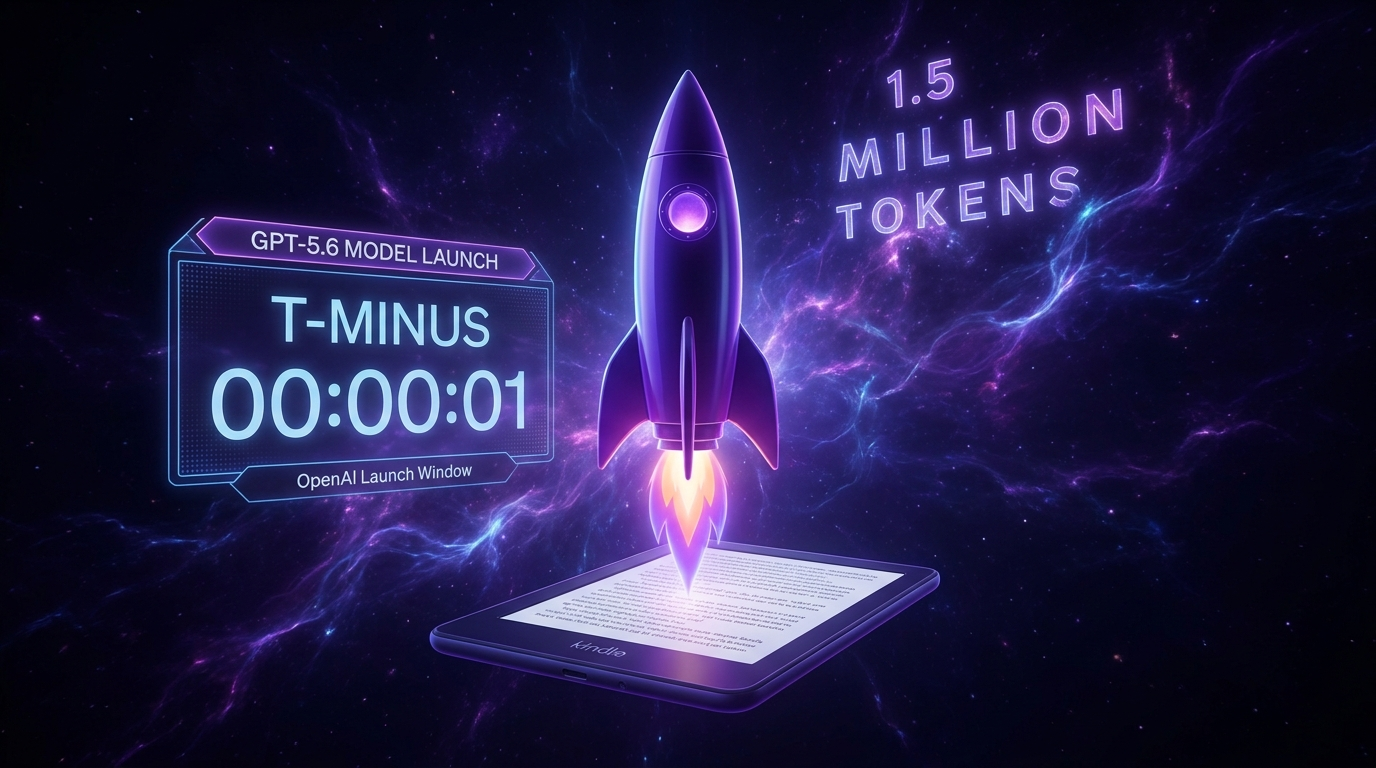
Status as of 23 June 2026: No official OpenAI announcement. 83% Polymarket probability of launch by 28 June. Internal codename "kindle-alpha" confirmed in Codex backend logs since mid-May. Chief scientist Jakub Pachocki confirmed internally as a "meaningful improvement." The launch window is open; the exact date is not confirmed.
What GPT-5.6 is expected to be
GPT-5.6 is positioned as a mid-tier model between GPT-5 and GPT-5.5 in terms of positioning, but with a specific capability emphasis: agentic workflows and long-context processing, rather than single-turn capability improvements.
Context window: 1.5 million tokens (43% larger than GPT-5.5's 1.05 million). Primary improvement focus: agentic workflows — multi-step tasks across tools and data sources. Secondary improvements: coding (10-15% efficiency gain over GPT-5.5), reasoning on structured documents. Expected API pricing: approximately one-third of current GPT-5.5 rates. No official OpenAI confirmation on any of these figures until the launch announcement.
The context window expansion is the most directly practical capability for UK small businesses. 1.5 million tokens is approximately 1.1 million words — enough to process an entire year of business correspondence, a full legal contract archive, or a complete project history in a single API call. For most small businesses, the practical value is not the ceiling but the floor: even moderate-context tasks become easier to automate when you do not have to manage chunking and context management yourself.
The pricing signal
If GPT-5.6 launches at one-third of GPT-5.5 rates, it continues the pattern that has characterised the OpenAI model cadence since GPT-4 in 2023: each generation of mid-tier models delivers more capability at lower cost than the previous mid-tier. GPT-4 to GPT-4 Turbo to GPT-4o to GPT-5 to GPT-5.5 each followed this trajectory. GPT-5.6 appears set to continue it.
Model inference costs fall as hardware improves and as training efficiencies compound. A model that cost £5 per million tokens to serve in January 2026 may cost £1.50 by December 2026 even if the model itself is unchanged — simply because the infrastructure running it is more efficient. GPT-5.6 benefits from both the efficiency gains in the new model architecture and the ongoing hardware cost reduction. For UK businesses building automation workflows, this means that even if GPT-5.6 is not significantly better than GPT-5.5 for your specific task, it may be worth switching for the cost saving alone.
The agentic focus: what it means for UK SMBs
OpenAI's emphasis on agentic workflow improvements with GPT-5.6 aligns directly with the 66% task success rate reported by Stanford — and with the AWS, Microsoft, and Google announcements all framing agents as the next enterprise workload layer. GPT-5.6 is being positioned to compete in this emerging agent infrastructure market.
For UK small businesses, the practical implication is that GPT-5.6 will likely perform better than GPT-5.5 on tasks involving multiple steps, tool use, and context maintained across a long workflow. If you are currently using GPT-5.5 through the OpenAI API for multi-step automation — document processing, CRM enrichment, multi-source research — GPT-5.6 is worth evaluating specifically for those tasks.
What to do
Write your test case today, before the launch
The operators who evaluate GPT-5.6 most effectively will be those who defined their test case before seeing the model, not those who scramble to evaluate it after the announcement hype. Your test case: one specific task you currently use an AI model for. Write down exactly what a good output looks like — format, accuracy, style, completeness. Define how you would decide the model is better or worse than what you currently use. Estimate the cost difference if you switched. When GPT-5.6 launches — expected any day between now and Sunday — run your pre-written test within 48 hours. Compare against your current setup. Make a deliberate decision: switch, test further, or stay. Do not evaluate GPT-5.6 reactively against a vague standard after the announcement. That is how every "new model" ends up feeling better even when it is not, because novelty reads as quality. The pre-written test case removes that bias.
If GPT-5.6 does not launch by 28 June, the 83% Polymarket odds become a useful calibration: either the model slips to July, or the prediction market was wrong. Either way, your test case will be relevant for the next model that does launch — and in 2026, the gap between major model releases is measured in weeks, not months.