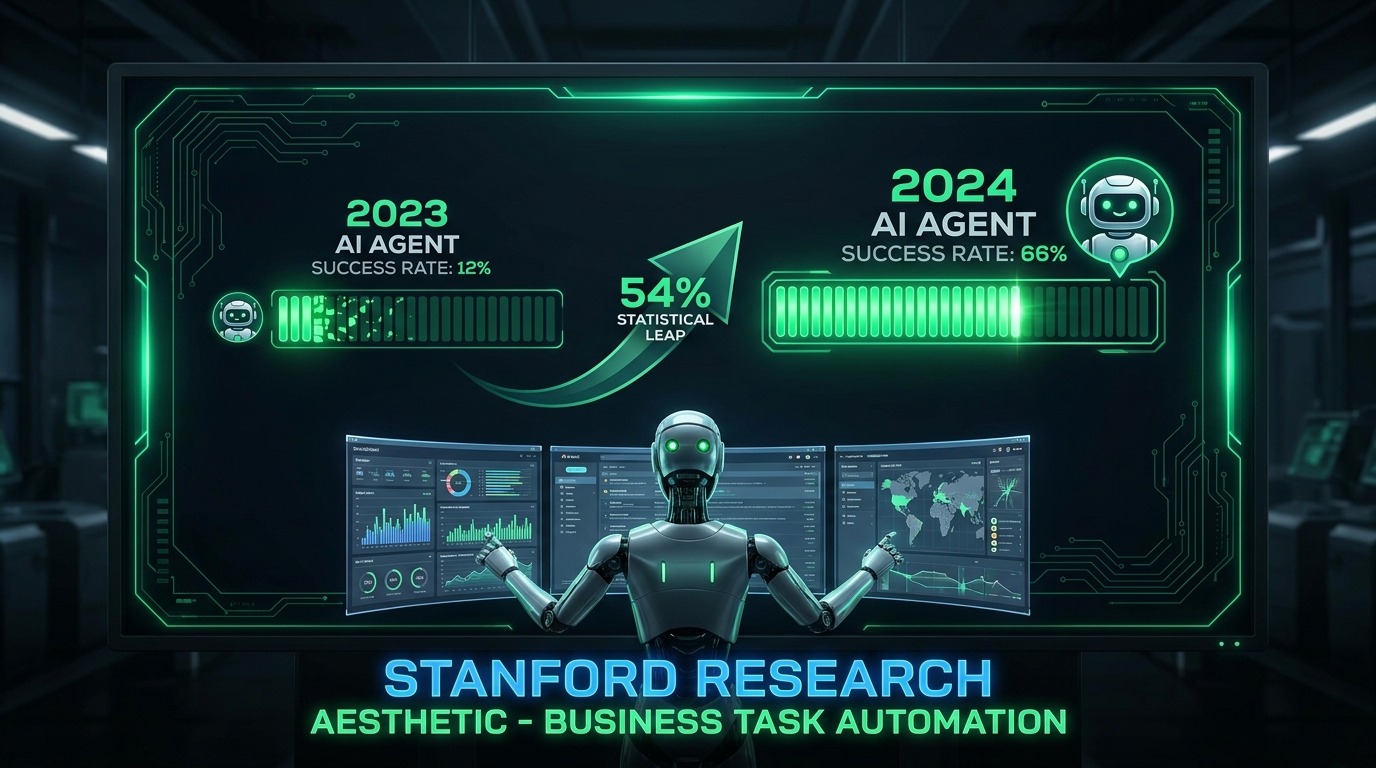
The short version: AI agents — systems that take a goal and execute a sequence of computer actions to achieve it — went from marginal to highly capable in twelve months. The 66% success figure is not a benchmark score; it is measured on real tasks: opening files, using apps, completing multi-step workflows, the kind of work that currently consumes hours of staff time weekly.
What the Stanford data actually measures
The Stanford 2026 AI Index tested AI agents on OSWorld and WebArena — benchmarks that require agents to use real software interfaces (not text interfaces) to complete tasks similar to what a human employee would do on a computer. Tasks include things like: navigate to a specific file, fill in a form across two apps, find information and move it to a spreadsheet, run a multi-step workflow across different platforms.
This jump is not a linear improvement — it is a step-change. In 2025, AI agents were failing more often than they succeeded on these tasks, which made them impractical for unattended business use. At 66%, they complete two-thirds of tasks correctly without human intervention. Six percentage points separate that from human-level performance (approximately 72% on the same benchmarks). The gap is closing faster than most researchers predicted twelve months ago.
Why every major cloud vendor made the same announcement
In June 2026, AWS used its Hong Kong summit to frame agentic AI as "the next enterprise cloud workload." Microsoft announced Agent 365. Amazon added always-on autonomous agents to its Quick platform with 16 integrations for non-engineering teams. Google's Workspace AI is expanding agentic task handling across Gmail, Drive, and Docs.
This coordinated framing is not marketing coincidence — it reflects the same underlying data. At 12% task success, agents were too unreliable to build business processes around. At 66%, they are reliable enough to automate defined, repeatable workflows. The vendors are announcing agent infrastructure now because the success rates finally justify enterprise commitment.
McKinsey's 2025 survey found 62% of organisations experimenting with AI agents, but only 23% had scaled agentic systems across the business. The 39-point gap between "experimenting" and "scaled" is largely explained by the trust threshold: organisations were waiting for reliability before committing. The 66% success rate — and the vendor platforms being built around it — is the signal that the wait is ending.
What this means practically for UK small businesses
The 66% figure is a fleet average across a range of tasks. For specific, well-defined, repeatable tasks — the kind that UK SMBs should be targeting first — agent success rates are already higher. The 66% figure includes complex multi-app workflows that small businesses are unlikely to attempt as a first use case.
1. CRM data entry from emails and calls: agents extract contact details, job titles, and conversation notes from inbound emails and populate CRM fields. Success rates on structured data extraction are well above 66%. 2. Appointment confirmation and reminder sequences: agents monitor calendar events, trigger personalised confirmation messages via email or SMS, and log responses. 3. Document processing: extracting data from invoices, purchase orders, or application forms and routing it to the correct system. AIFA's 10 International case study reduced this from 60 minutes to 7 minutes per document using an early version of this workflow.
The key principle for UK small businesses is to start with defined, repeatable tasks where success is easy to verify — not creative or judgement-heavy tasks. A document extraction agent that works 80% of the time and has a human review step for the other 20% is genuinely valuable. An agent that handles complex customer complaints with mixed results is not yet a viable unattended workflow.
What to do
One action: identify your first agent workflow this week
Name one task in your business that is: (a) highly repeatable — the same steps every time, (b) currently taking 15 or more minutes of staff time per occurrence, and (c) based on structured inputs — emails, forms, documents, calendar data. That is your first agent workflow candidate. Write it on a card: what triggers it, what steps it involves, what the output looks like, how you would know it worked. If that description fits neatly on one side of an A5 card, you have a viable first agent workflow. If it does not fit, it is too complex for a first attempt. Keep narrowing until it fits.
The 66% success rate is remarkable context, but the more actionable number for your business is this: McKinsey found that businesses that had scaled even one agentic workflow reported measurable time savings of two or more hours per week per team member involved. Over a year, that is 100+ hours per person. The statistical leap from 12% to 66% happened in the AI labs. The productivity leap for your business happens when you name the workflow and run the first pilot.