The Expensive Truth Nobody Tells Solo Founders
Most "failed startups" weren't bad ideas. They were unvalidated ideas. The difference is brutal: a bad idea costs you a few hours of journaling, an unvalidated one costs you 3-12 months of nights and weekends building something nobody wanted.
I've built and rebuilt my own businesses three times — chimney sweeping, wood stove installation, and now an AI consultancy. Every one of those rebuilds traces back to something I should have tested in the first week and didn't. So when I started talking to other solo founders about their ideas, the same pattern kept coming up: a strong gut feeling, a domain name already registered, and a half-built MVP — but no clear answer to "why would someone choose this over what they already do?"
If you're a solo founder, indie hacker, or anyone with an idea you're tempted to start building, this post is for you. We'll cover:
- The six dimensions every idea has to score on
- Why most ideas pass on three of them and quietly fail on the others
- How to use a free 3-minute scorecard to find your weakest link before you write a line of code
The Six Dimensions of a Validatable Idea
Validation isn't a single yes/no question. It's six questions that interact with each other. Score badly on one and the others can't save you.
1. Problem-Solution Fit
If you find yourself saying "for everyone who…" or "for businesses that…", you've already lost. Vague problem definitions produce vague solutions and vague solutions don't sell. The strongest founders I've talked to can name three specific people who have the problem and what they currently do about it.
2. Market Opportunity
"Everyone" is not a market. "Small businesses" is not a market. "Independent chimney sweeps in the south of England who don't yet use a CRM" is a market — you can list them, you can email them, you can knock on their doors.
3. Competitive Advantage
"Better UX" or "cheaper" rarely works as a wedge for a solo founder. You usually need a fundamentally different approach — a different audience, a different distribution model, a sharper specialisation. If your honest answer is "I'll figure it out as I go," you have no advantage yet.
4. Business Viability
Free tools that "we'll monetise later" almost never get monetised. Ads pay pennies. The strongest signal is people already paying for an alternative — that proves willingness to pay. The next-strongest is people telling you "I'd pay for this" while reaching for their wallet.
5. Execution Readiness
The longer your build, the more dangerous unvalidated assumptions become. If your scope is too big to ship a v0 in a few weeks, cut it ruthlessly. The smallest possible version that solves the core problem is the only thing that matters.
6. Founder Fit
This isn't about credentials. It's about access and obsession. Do you live the problem daily? Are you in the community that has it? Will you still care about this in two years when it isn't fun anymore? If your honest answer is "I just think it's cool", that's not enough fuel to push through the dark months.
Why Most Ideas Pass Three and Fail Three
Here's the pattern I see most often. A founder has a clear problem (1), they live it themselves (6), they know they could prototype it quickly (5). So they start building.
What they haven't done:
- Tested whether the problem is shared by enough people in a reachable group (2)
- Worked out why their version beats the existing alternatives (3)
- Confirmed someone will actually pay (4)
Three months later they have a polished v1 and one user (themselves). The fix wasn't to build harder. The fix was to score the idea before starting and address the gaps deliberately.
What "Validation" Actually Looks Like in Practice
Validation isn't a survey or a focus group. It's a series of small, cheap experiments that move each of those six dimensions from "maybe" to "yes" or "no":
- Problem-Solution Fit: Talk to five real people in your target group. Don't pitch — listen. Ask them to describe the problem in their own words.
- Market Opportunity: Define your ICP in one sentence. Try to list 100 specific examples. If you can't, the niche is too vague.
- Competitive Advantage: Map your top three competitors. Find what they all miss and make that your wedge.
- Business Viability: Look at how similar tools price. Talk to people who already pay for the alternatives. Ask them what's missing.
- Execution Readiness: Cut your v0 scope until you can build it in two weeks max. Anything that doesn't directly solve the core problem gets parked.
- Founder Fit: Honestly assess your access to the audience. If you don't have it, partner with someone who does — or pick a different problem.
Each of these takes a few hours. None of them require writing code.
A 3-Minute Shortcut to Find Your Weakest Link
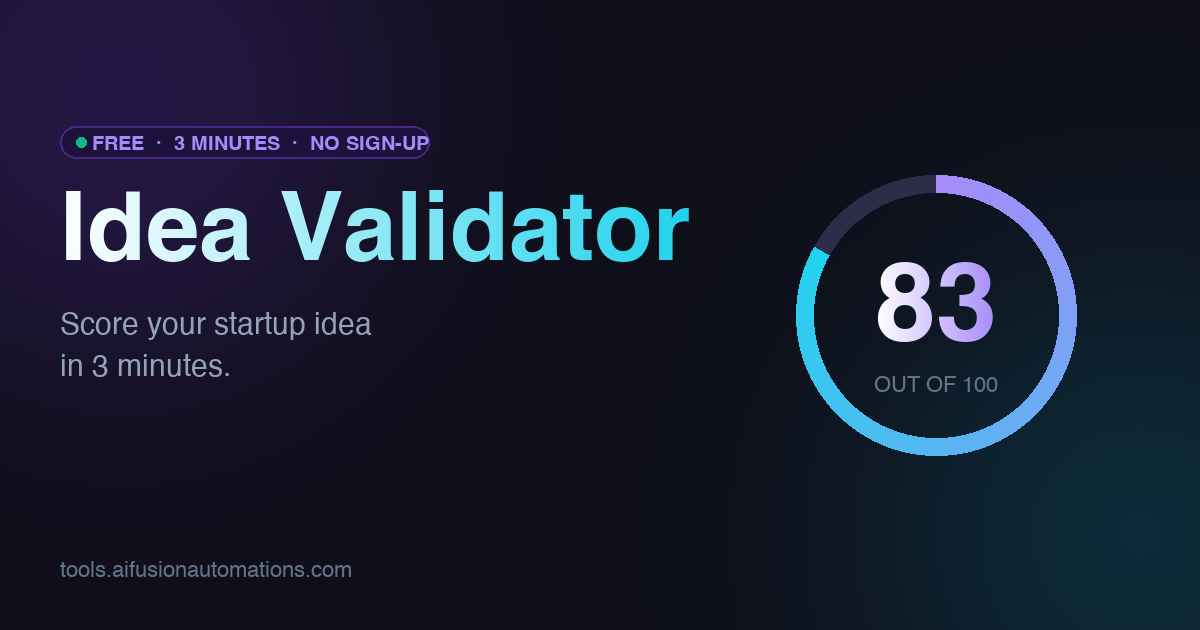
To make this faster, we built Idea Validator — a free tool that walks you through eight short questions and scores your idea on all six dimensions in under three minutes.
You'll get:
- An overall validation score (0–100)
- A breakdown by each of the six dimensions, with a colour-coded bar
- A short verdict explaining what the score means
- The top three concrete next steps you should take, ranked by which gap is most dangerous
- A downloadable PDF report you can share with a co-founder, mentor, or yourself in three months
There's no sign-up, no email-gate. The tool runs entirely in your browser. If you want a personal review afterwards — where I read your submission and send back a one-page action plan — you can drop your email and I'll be in touch within 48 hours. Otherwise, just take the score and run.
What to Do With Your Score
70+ — Promising. Sharpen the weakest dimension and start building the smallest possible version. Talk to five more potential users this week.
50–69 — Mixed signals. You have some good ingredients but real risks remain. Don't build yet. Pick the lowest-scoring dimension and run a single experiment to move it.
Below 50 — Too early. That doesn't mean kill the idea. It means you don't yet know enough to validate it. Spend a week interviewing real people in the target group and re-score.
The goal isn't a perfect 100. The goal is to know exactly where you'd lose if you started building today.
Who This Tool Is For
- Solo founders working on their first or fifth idea
- Indie hackers deciding which side project to commit to
- Service-business owners thinking about productising into software
- Anyone who's about to spend more than a weekend building something they haven't pressure-tested
If you're in the early "should I build this?" zone, the validator will give you a sharper answer in three minutes than another week of journaling will.