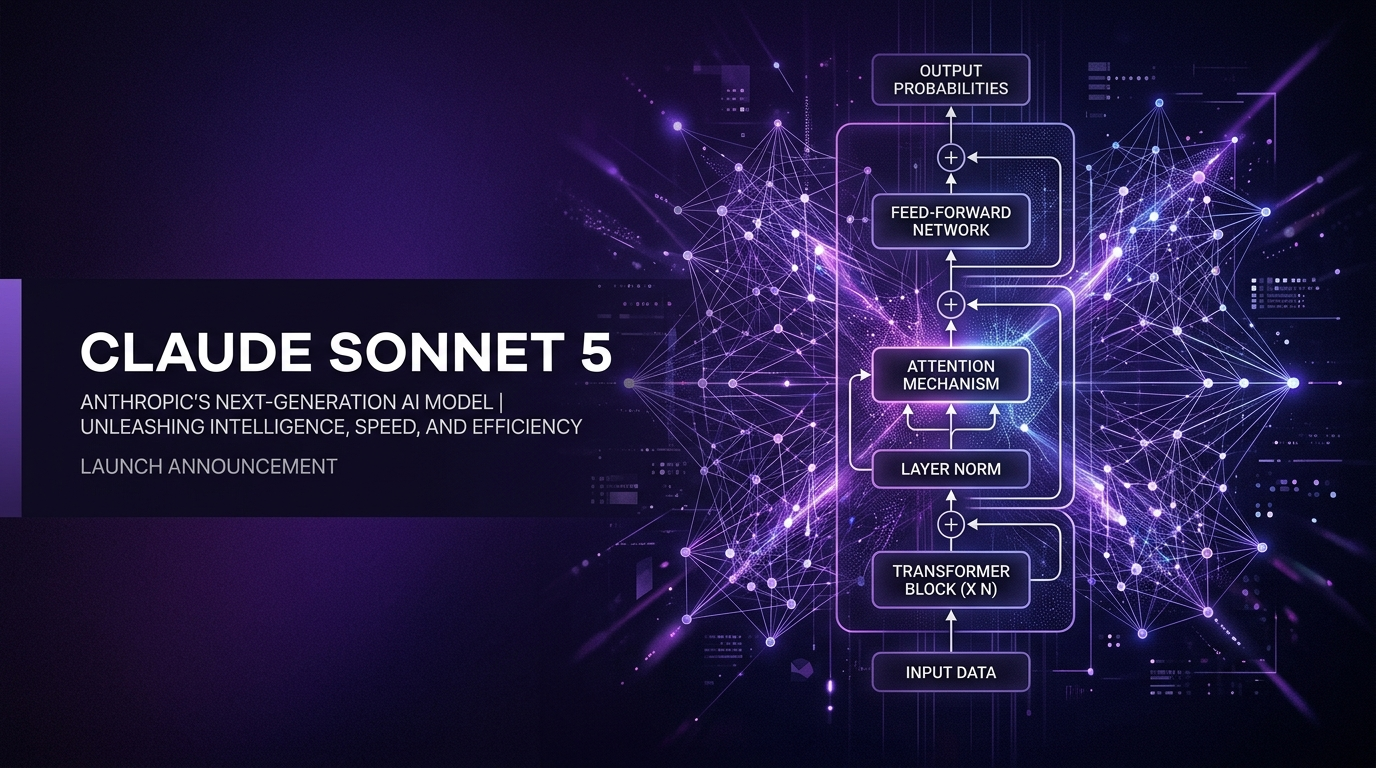
The short version: Anthropic has switched all Claude plans to Sonnet 5 as the default. You do not need to do anything to get it if you are already a subscriber. The model is near-Opus quality and costs significantly less than Opus to run through the API. The promotional price through 31 August is $2 per million input tokens and $10 per million output tokens — rising to $3/$15 on 1 September.
What Sonnet 5 actually does differently
Claude Sonnet 5 is described by Anthropic as a more powerful and agentic version of the midsize model. Three changes are practically meaningful for business users:
- Agentic capability: Sonnet 5 can make plans, use tools like web browsers and file systems, and run tasks autonomously over longer horizons. Previously, this level of autonomous operation required Opus. Now it is available on every plan.
- Native 1-million-token context window in Claude Code, meaning it can hold an entire large codebase, contract set, or document library in a single conversation.
- Near-Opus benchmark performance across coding, writing, analysis, and reasoning — at a price point closer to mid-tier models.
For the API pricing context: GPT-4o launched at $5/$15 per million tokens in 2024. Sonnet 5 at $2/$10 through August is approximately 60% cheaper on input and 33% cheaper on output than GPT-4o's launch price, at comparable or better capability. The frontier price of 2024 is now the promotional mid-tier price of mid-2026.
What this means for UK small businesses
Most UK service businesses are not running Claude through the API — they are using the claude.ai interface directly. For those users, the upgrade is automatic and costs nothing extra within their existing plan tier. The practical experience change is that complex tasks — multi-step reasoning, long-document analysis, drafting multi-section reports — will now produce better outputs than before without any change in workflow.
For businesses considering building AI workflows into their operations (quote generation, customer query handling, appointment processing), Sonnet 5 removes a pricing objection that existed six months ago. Running 10,000 AI tasks through the API at $2/$10 per million tokens costs a fraction of what equivalent Opus calls would have cost in 2025.
Anthropic has deprecated fast mode for Claude Opus 4.7, with removal on 24 July 2026. If your team is using Opus 4.7 with fast mode enabled, switch to Opus 4.8 fast mode before that date. Sonnet 5 is now the recommended default for most tasks regardless.
The September price cliff
The promotional pricing ends on 31 August. From 1 September, Sonnet 5 through the API will cost $3/$15 per million tokens — still cheaper than Opus 4.8, but 50% more expensive than the current promotional rate. If you are evaluating whether to build API-based workflows, August is the time to pilot them. The decision about whether to run at the higher September price is easier once you have real usage data.
Operator actions
Today: Log into claude.ai and run your most complex recurring task. The output quality may surprise you compared to previous Sonnet versions. Document the result as a Q3 baseline.
This month: If you are on the API, update your model parameter to claude-sonnet-5 and start measuring cost and output quality against your previous model. August is your pilot window at promotional pricing.
By 31 August: Decide whether to continue at the September price or route lower-complexity tasks to a cheaper model tier. Audit your AI tasks by complexity before then.