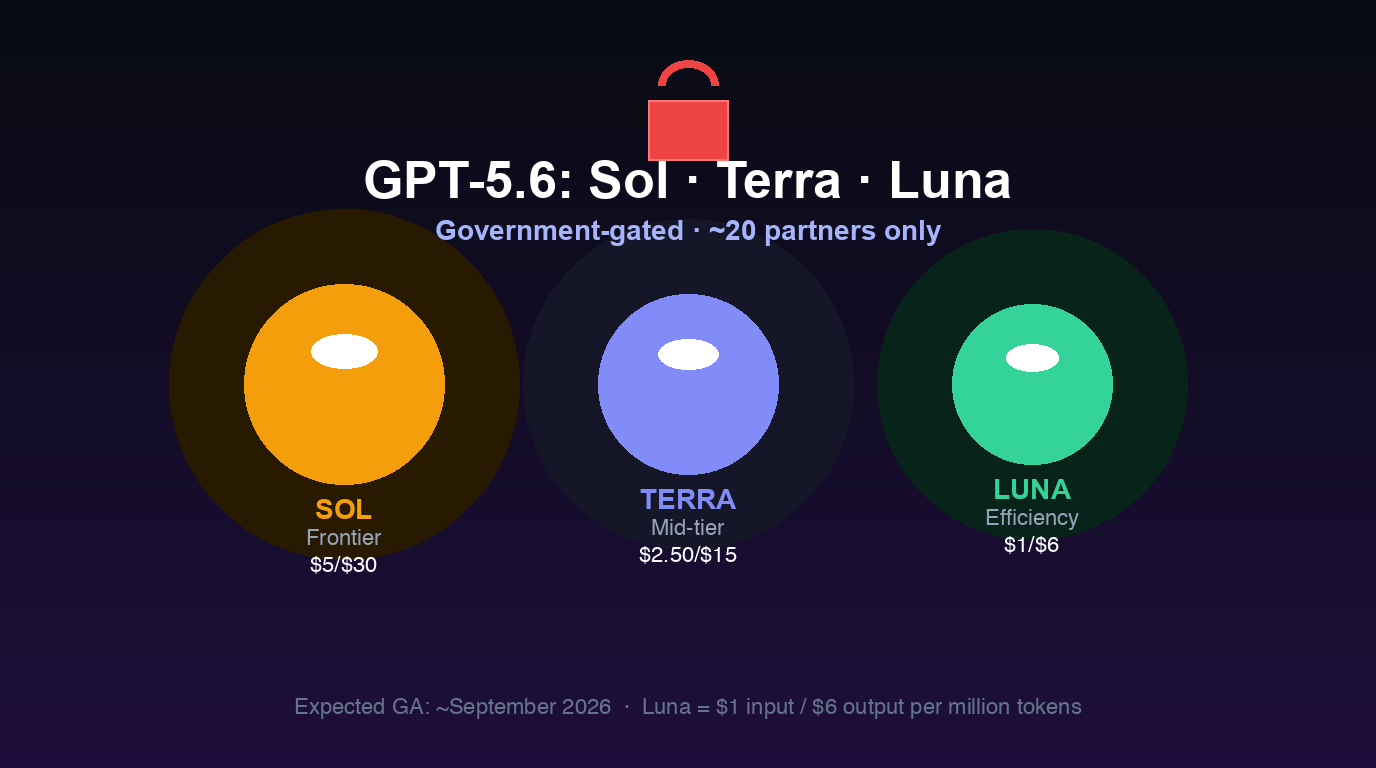
What happened: OpenAI launched the GPT-5.6 model family on June 26, 2026 in a restricted preview limited to approximately 20 government-approved partners, following a White House request tied to the models' cybersecurity capabilities. The family comprises three models: Sol, Terra, and Luna. Most businesses — including UK businesses — cannot access them yet. When the gate lifts, expected within 60–90 days, the pricing structure will be significantly lower than current GPT-5.5 rates.
The three models: what they are and who they are for
Pricing: $5 input / $30 output per million tokens — identical to GPT-5.5's current rate card. Sol is positioned as the highest-capability model in the family, designed for the most complex tasks. For UK businesses, Sol will likely only make sense for specialised applications where maximum reasoning power justifies the cost.
Pricing: $2.50 input / $15 output per million tokens — approximately half the cost of Sol and GPT-5.5, with GPT-5.5-competitive performance according to internal benchmarks. Terra is the model that will matter most for UK businesses once the gate lifts. Frontier capability at half the frontier price is a meaningful shift for any API user.
Pricing: $1 input / $6 output per million tokens — the lowest in the family and the price signal of the quarter. For context, GPT-4o launched at $5/$15 per million tokens in 2024. Luna at $1/$6 represents an 80% reduction in input costs versus a model from two years ago. This trajectory — frontier prices becoming mid-tier prices within two years — has direct implications for how UK businesses should plan their AI spend.
Why the government gate exists and how long it will last
OpenAI gated the GPT-5.6 family following a White House request, with the stated rationale being the models' advanced cybersecurity capabilities. Government-gated releases have become an emerging pattern in 2026 — Anthropic's Mythos model family received similar scrutiny earlier this year. The pattern reflects growing government attention to AI systems with capabilities that could be weaponised in cyber attacks or disinformation campaigns.
For UK businesses, the practical question is when the gate lifts and access becomes general. Based on previous model release patterns, the likely timeline is 60–90 days from the June 26 launch — placing general availability in September 2026. This is an estimate, not a confirmed date. If you plan to use GPT API models in any project launching before September, design for GPT-5.5 compatibility rather than waiting for 5.6.
What Luna's pricing tells you about the next 18 months
The most important thing about the GPT-5.6 launch for UK small businesses is not the government gate — it is the Luna price point. At $1 input / $6 output per million tokens, Luna closes to a fraction of what frontier AI cost two years ago. The implication is straightforward: AI will continue to get significantly cheaper through 2026 and 2027.
This matters for UK business planning in two ways. First, AI tools you cannot currently afford at scale may be accessible within 12–18 months at the prices these models are establishing. Workflows that require large volumes of AI calls — processing every customer email, generating a quote for every enquiry, summarising every phone call — become economically viable as per-token costs fall toward zero.
Second, the mid-tier models available today at $2–3 per million tokens are already extremely capable for most business tasks. The efficiency opportunity is not to wait for cheaper models — it is to use the already-cheap current models more consistently.
Operator action: three moves for UK businesses
Move 1 — No action needed on GPT-5.6 today. The gate means you cannot access it regardless. Continue using whichever OpenAI model works for your current workflows. Design any new project for GPT-5.5 compatibility.
Move 2 — Use Luna's pricing as your planning benchmark. If there is an AI-assisted workflow you have been putting off because cost per call is too high, build it out on paper now using $1/$6 per million tokens as your cost assumption. When Luna becomes available, you will be ready to test it immediately.
Move 3 — Consider the efficiency tier first when Sol/Terra/Luna opens. Start with Luna on your lowest-complexity tasks. Only move to Terra or Sol if Luna's output is insufficient. This is the model routing approach that advanced AI users are adopting across the industry.