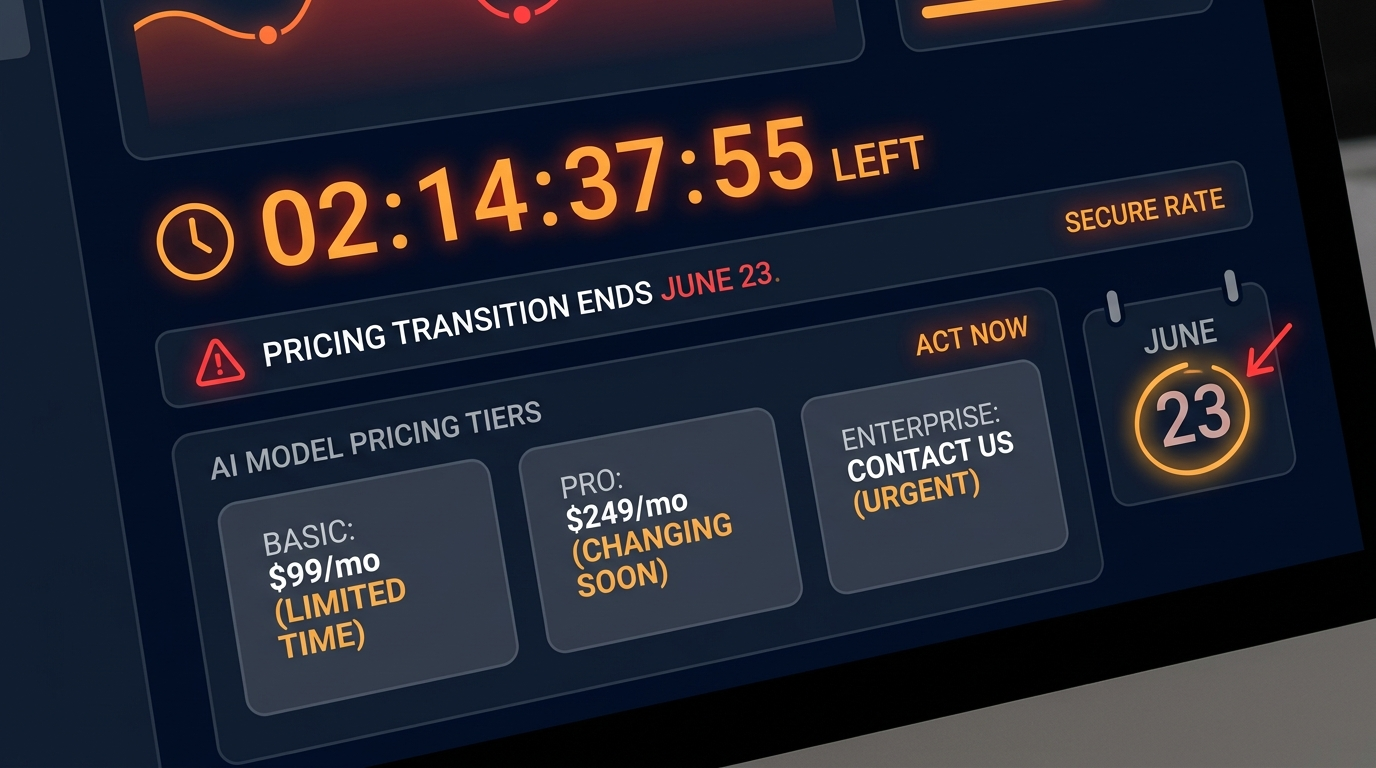
The deadline that matters: Anthropic's Claude Fable 5 — its first Mythos-class model available to the general public — has been included in Pro, Max, Team, and seat-based Enterprise plans at no extra cost since its launch on 9 June. That changes on Monday 23 June. From that date, Fable 5 requires usage credits at $10 per million input tokens and $50 per million output tokens. If your team has been testing or relying on Fable 5 access this fortnight, you need to know what happens next.
What Claude Fable 5 actually is
Launched 9 June 2026, Claude Fable 5 is Anthropic's public-facing version of its Mythos-class architecture. It outperforms all previous Claude models across tested benchmarks including software engineering, knowledge work, scientific reasoning, and vision. The model carries guardrails that restrict responses in high-risk domains such as advanced cybersecurity and biology — those capabilities are reserved for the separate Mythos 5 model, which is limited to government-adjacent users and Glasswing partners. For business purposes, Fable 5 is the relevant model: it is significantly more capable than Claude Sonnet 4.6 for complex reasoning, long-document analysis, and nuanced writing tasks.
The two-week free inclusion window was Anthropic's standard practice for major model launches — give all paid subscribers access to evaluate the model before transitioning to credit-based pricing. That window closes on 22 June.
The export control complication
There is a parallel issue that affects some users more than the pricing change. On 12 June 2026, a US government export control directive required Anthropic to take Claude Fable 5 and Mythos 5 offline globally. As of Saturday 21 June, the Fable 5 API endpoint is still returning errors for some users. This is a US-driven restriction with no direct impact on the legality of UK businesses using Claude — but it does affect API availability for those testing Fable 5 in automated workflows.
The practical implication: if you have been evaluating Fable 5 via the claude.ai web interface during the free window, that evaluation period has been disrupted. If your use case is API-dependent, the service interruption means you may have had less opportunity to assess the model properly before the pricing deadline arrives.
The pricing structure in plain terms
For context, one million tokens is roughly 750,000 words of text — the equivalent of about 10 full-length business books. For most small business users interacting via the claude.ai interface, token consumption is counted per conversation and is unlikely to make Fable 5 dramatically more expensive than standard usage on Sonnet or Haiku tier. For businesses using the API to process large documents, run automated workflows, or generate substantial output content, the cost is meaningful and should be modelled before relying on Fable 5 in production.
The current Claude Sonnet 4.6 model remains included in plan pricing as before — the pricing change applies only to Fable 5. Businesses that do not specifically need Mythos-class capability can continue using Sonnet 4.6 at their existing plan cost with no change.
What this means for UK businesses specifically
UK businesses using Claude through claude.ai plans (Pro at £17/month, Team at £25/month per user) should note that from 23 June, Fable 5 access will consume credits rather than being included in the base plan price. Anthropic has not yet published a UK-specific credit pricing page, but credits are billed in US dollars — the effective cost will fluctuate with the GBP/USD rate.
For businesses that have built workflows or agent pipelines that depend on Fable 5's capability level, the transition requires a cost-benefit assessment: is the improvement in output quality from Fable 5 over Sonnet 4.6 worth the per-token cost differential in your specific workflow? For most routine business tasks — email drafting, CRM data entry, meeting summaries — Sonnet 4.6 is more than adequate and remains cost-included in plans. Fable 5 adds genuine value for complex reasoning tasks, long-context analysis, and cases where output quality directly drives revenue outcomes.
What UK operators should do before Monday
Test Fable 5 on your hardest task today: If you have not yet evaluated Fable 5, use the remaining free access hours (until 22 June) to test it on the most complex task your business regularly performs with AI. Compare it to Sonnet 4.6 directly. Does it produce noticeably better output? If not, stick with Sonnet.
Estimate your token consumption: If you use the API, check your Anthropic usage dashboard for your average monthly token consumption. Apply the $10/$50 input/output rate to estimate what Fable 5 would cost you per month. Build that into your AI tool budget before switching.
Plan for the service interruption: If the API is still returning errors when you attempt to test, that is the export control disruption — not a problem with your account. Monitor Anthropic's status page for the all-clear before assuming Fable 5 is unavailable permanently.
Default back to Sonnet 4.6 for most workflows: Unless you have a specific high-complexity use case that Fable 5 demonstrably handles better, the rational default is to continue on Sonnet 4.6. Reserve Fable 5 credits for the tasks where the quality difference is measurable and consequential.
Need help assessing the ROI? AIFA offers a free AI workflow audit that includes model selection — if you want an independent view on whether Fable 5 is worth the cost for your specific workflows, book a session.