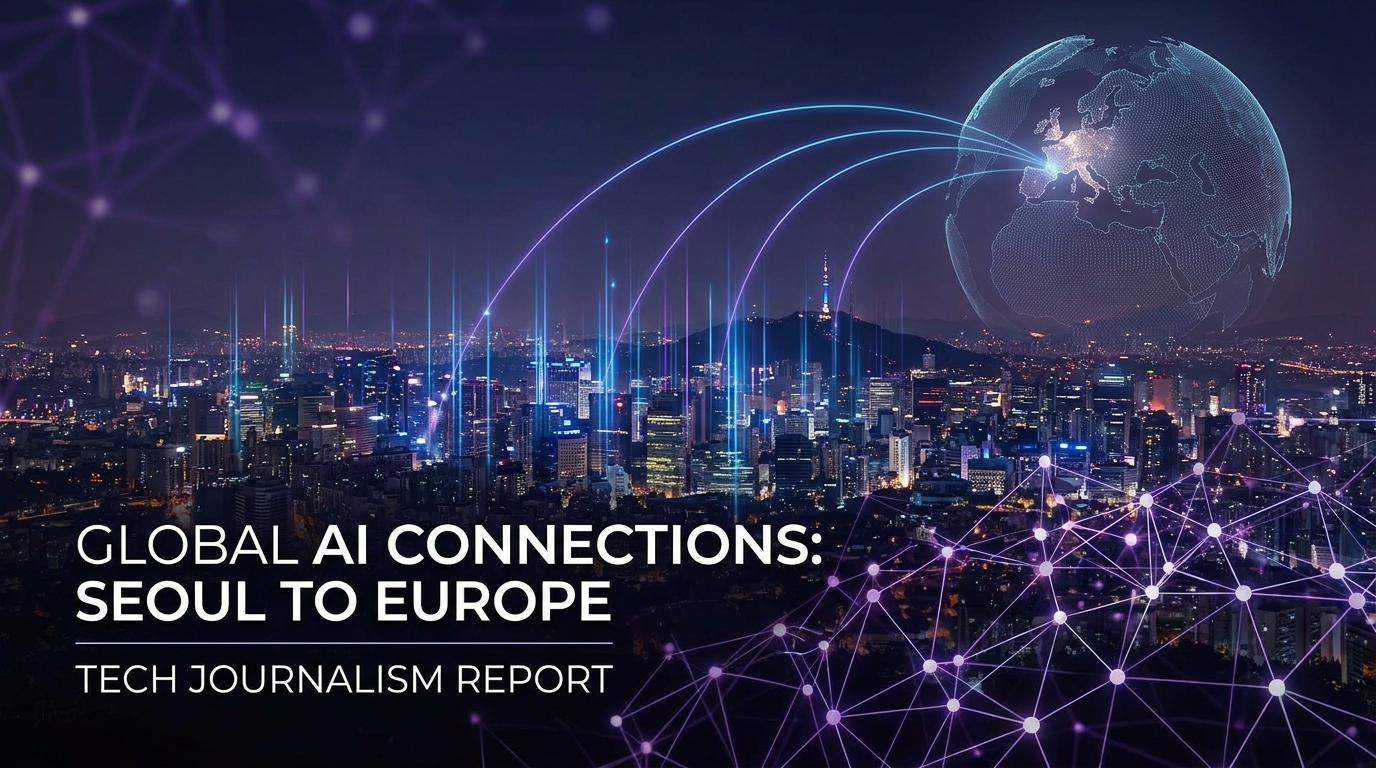
Bottom line for UK businesses: Anthropic opened its Seoul office on 18 June, signed a memorandum of understanding with South Korea's Ministry of Science and ICT on AI safety and cybersecurity, and simultaneously navigated a US government export control situation affecting access to its most advanced models in South Korea. UK access to Claude is entirely unaffected. What matters for UK operators is the broader signal: AI capability is now explicitly treated as geopolitical infrastructure, and your choice of AI provider carries implications that extend beyond features and pricing.
What happened in Seoul
The MOU with South Korea's Ministry of Science and ICT covers three areas: analysis of AI's impact on cyber offence and defence; evaluation of AI model safety and misuse risks in Korean-language contexts; and red-team assessments of autonomous AI agents. The Korea AI Safety Institute is the primary partner for model safety evaluations. Separately, Anthropic is deepening ties with South Korean enterprises and the broader developer community through the new office.
The timing is notable: WIRED and The Washington Post reported that SK Telecom, South Korea's largest mobile carrier and a $100m Anthropic investor, was identified by US national security officials as a concern related to AI model access. The White House subsequently imposed export controls on Anthropic's most advanced models for that market. At the Seoul press conference, Anthropic's Managing Director of International said the company was "very confident that in coming days the models will become available again" — the most specific confidence signal Anthropic has given publicly on resolution timeline.
Why the governance angle matters for UK businesses
The short answer is that AI has officially entered the same strategic category as semiconductors, satellite communications, and advanced defence technology. National governments — including the UK — are treating AI capability as infrastructure that requires management, not just regulation.
For UK businesses currently using or evaluating AI tools, this creates a practical consideration that did not exist two years ago: which countries and jurisdictions are behind the AI platforms you depend on, and how stable is that access? Claude is a US company with UK operations and a strong relationship with the DSIT AI safety programme. That relationship, established through the AI Safety Institute and the 2023 Bletchley Declaration, means the UK is a preferred partner market — not a restriction target. UK access to Anthropic's full model range is structurally well-positioned.
The AI safety MOU — what it tells us about Claude's direction
The specific areas covered by the Korea MOU are worth noting for UK businesses: AI's impact on cyber threats, Korean-language model safety, and red-team assessments of autonomous AI agents. This is not standard regulatory compliance work. This is Anthropic volunteering to participate in adversarial testing and national security evaluation — the kind of engagement that typically precedes deeper enterprise adoption in regulated sectors.
For UK businesses in professional services, healthcare, legal, and financial sectors where AI adoption has been slower due to governance concerns, this trajectory is significant. Anthropic is actively building the trust infrastructure that enterprise adoption requires. That work is slower and less visible than new model releases — but it is what makes AI viable in the long term for regulated industries.
The new Claude enterprise MCP connectors — the other story from this week
Admins on Claude Team and Enterprise plans can now configure which tools Claude has access to at the organisation level. Individual employees simply log in and receive automatic access — no per-person authorisation steps. Launch partners include Asana, Atlassian, Figma, and Supabase. Slack is coming. This is the enterprise AI rollout friction problem being solved at the product level.
If your business is evaluating Claude for team-wide use, this development removes one of the main practical blockers: getting consistent, secure access across a team without an IT project. For UK SMBs without dedicated IT resource, zero-touch provisioning is the difference between AI being something the founder uses and AI being something the whole team uses.
What UK operators should do with this information
If you currently use Claude for Business: Check whether your plan (Team or Enterprise) qualifies for the new managed MCP connectors. Review the seven launch partners — Asana, Atlassian, and Figma in particular are widely used in UK SMBs.
If you are evaluating AI providers: The Anthropic-UK relationship (DSIT, AI Safety Institute, Bletchley) is a practical consideration alongside features and pricing. It is one factor that reduces long-term access risk for UK businesses.
On the export control story: No UK action required. Monitor for resolution of the South Korea situation — Anthropic expects models to be available again in coming days.
On the broader governance signal: If your sector (healthcare, legal, financial services) requires AI with strong safety credentials, Anthropic's active engagement with national AI safety institutes is worth tracking as evidence of enterprise readiness.