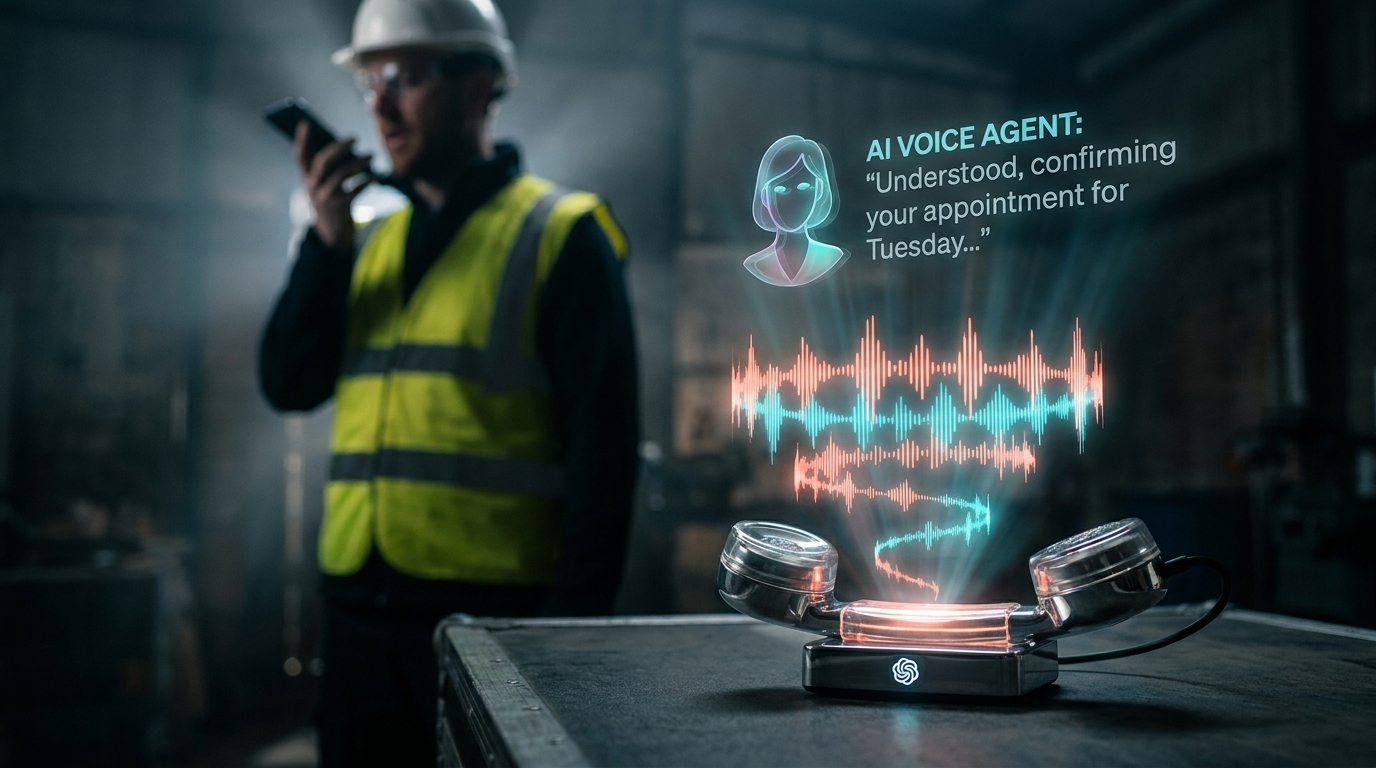
The short version: OpenAI's Realtime API has moved from beta to general availability with three new audio models: GPT-Realtime-2 for live voice conversations, GPT-Realtime-Translate for real-time language translation across calls, and GPT-Realtime-Whisper for production-grade speech-to-text transcription. Beta means experimental and subject to change. General availability means production-ready and stable. For any business that was waiting for AI voice tools to mature enough to build on, that threshold has now been passed.
What the three new Realtime models do
This is the core conversational model — it handles real-time voice input and output with low enough latency to feel natural in a phone call. This is the engine behind AI receptionists, voice agents, and automated phone support. Moving from beta to GA means OpenAI is committing to stability — the API contract, the pricing, and the performance characteristics are now production commitments, not experimental ones.
This model handles translation in real time during a call — not post-hoc, but live, as the conversation is happening. For UK businesses serving customers who speak other languages, or businesses with international suppliers and clients, this removes a meaningful communication barrier without requiring a human translator or specialist software.
Whisper has been OpenAI's speech-to-text model for some time, but moving it into the Realtime API with a GA commitment is significant. Every call can be transcribed in real time and automatically. For service businesses that currently lose information between a phone call and a CRM entry, real-time transcription with automatic logging is a direct answer to that problem.
What this means for UK service businesses running on phone calls
A large proportion of UK small service businesses still run primarily on telephone enquiries. A chimney sweep, a plumber, an electrician, a cleaning company, a childminder — the phone call is often the first interaction a potential customer has, and it happens at times the owner cannot always answer: early morning, evening, lunch, or when they are already on a job.
The missed call is one of the most consistent and measurable sources of lost revenue for service businesses. Industry estimates suggest that 40–60% of missed calls do not result in a callback — the customer simply moves on to the next provider. An AI receptionist that picks up every call, takes the enquiry, provides the right information, and books an appointment or sends a follow-up closes that gap. Until now, the reliability of voice AI tools made this feel like a risk rather than a solution.
Beta software carries a real risk for business-critical applications: the API can change, pricing can shift, performance can degrade between model updates. Developers and agencies building AI receptionists on top of a beta API are building on shifting ground. GA removes that uncertainty. The Realtime API now comes with the stability commitments that make it sensible to build a customer-facing product on top of it.
The AI receptionist is no longer a future product
AIFA has been planning an AI receptionist offering for UK service businesses for some months — specifically tracking the maturity of voice AI infrastructure. The OpenAI Realtime API reaching GA is a meaningful step in that timeline. The underlying capability is now production-grade. What remains is the configuration: connecting it to a business's booking system, scripting the call flows, setting the escalation rules, and testing it against real enquiry patterns before going live.
For service businesses interested in an AI receptionist, this is the right time to start scoping what it would look like — not to build it tomorrow, but so that the build timeline is realistic and the design is grounded in how the business actually takes calls today.
What to do with this
If you miss calls regularly: Track it for one week. Count the calls you cannot answer, and estimate how many of those result in a booking. That number is the revenue case for an AI receptionist.
If you already have a CRM: Ask your provider when they are integrating real-time call transcription. If the answer is "not on the roadmap," that is a data quality problem you can solve with an AI layer today.
If you are building AI products: The OpenAI Realtime API is now the production-grade foundation for voice agent development. The beta constraint on building customer-facing voice applications has been removed.