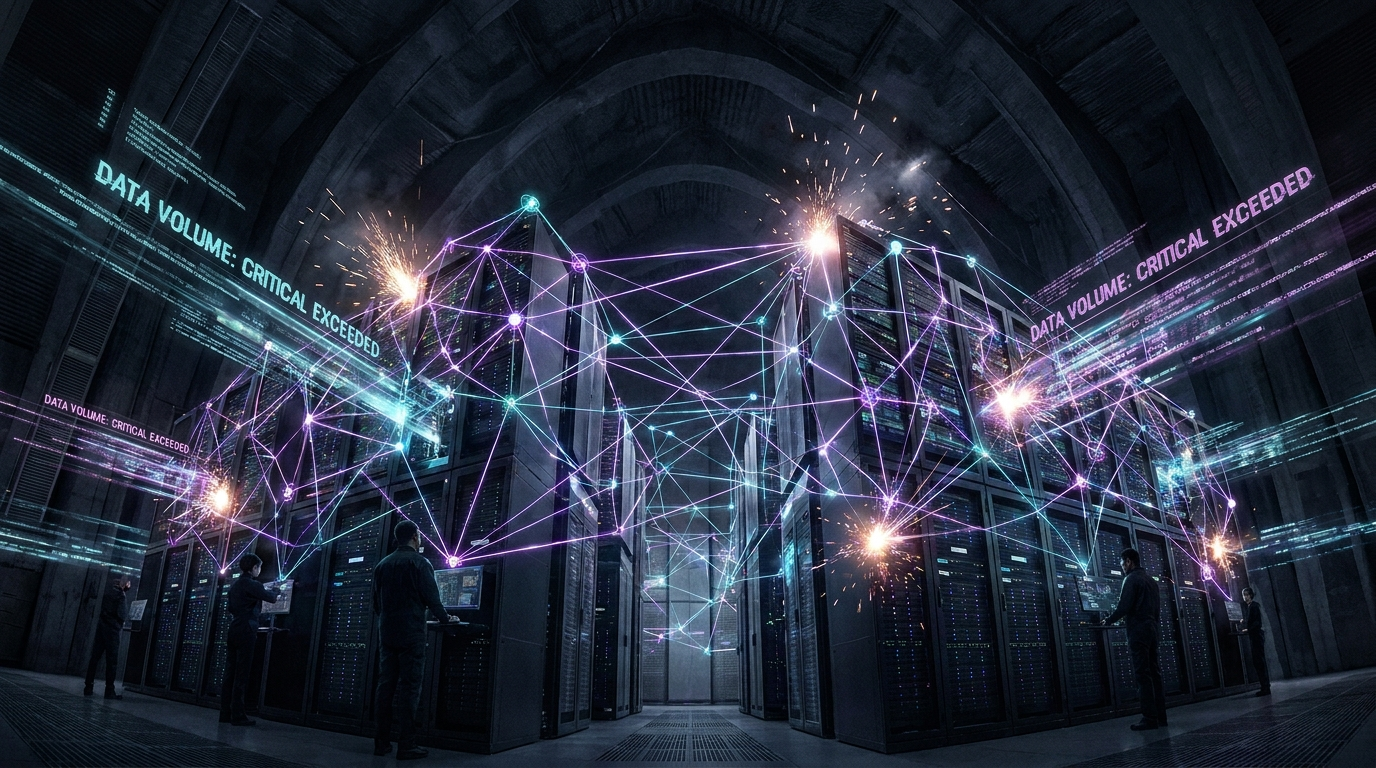
The short version: This week produced data points that individually read as tech-industry trivia but together mark something important. AI agents are now generating so much automated activity that the infrastructure beneath the tools many businesses use every day has bent under the weight. That is not a warning — it is evidence that AI adoption has crossed from optional enhancement to economic baseline.
Signal 1: GitHub hit 275 million commits in one week
Microsoft confirmed on 16 June that GitHub is now processing 275 million commits per week, on pace for 14 billion in 2026. In 2025 it processed 1 billion for the entire year. GitHub Actions compute minutes have grown from 500 million in 2023 to 2.1 billion in early 2026. The overwhelming majority of that growth is AI agents running automated code tasks, not human developers.
To put this in context: in 2025, the entire global software development community produced 1 billion commits annually across GitHub. In the first five months of 2026, AI coding agents are on pace to produce fourteen times that. The platform was not built for this volume.
Signal 2: Microsoft routed GitHub through AWS
The consequence of Signal 1: Microsoft was forced to route GitHub infrastructure through Amazon Web Services to handle the load. A company that runs the world's largest cloud platform (Azure) needed a competitor's capacity to keep its developer platform online under AI-driven demand.
When the operators of foundational AI infrastructure need to buy capacity from their largest competitor to keep the platform running, it indicates that real-world AI adoption is outpacing even the most generous capacity projections made twelve months ago. The infrastructure owners were wrong about how fast this would move.
Signal 3: Anthropic and Google are spending at extraordinary scale
Separately confirmed this week: Anthropic is paying SpaceX approximately £1.25 billion per month for compute at the Colossus 1 facility. Google is paying SpaceX approximately £920 million per month for compute capacity. These are the two largest AI companies — and they cannot keep up with their own model infrastructure demand through conventional data-centre procurement. Both are contracting with a rocket company to run AI.
The practical implication for businesses: AI compute costs are not falling as fast as the public AI pricing tables suggest, because the underlying infrastructure demand is rising faster than supply can be built. Today's pricing is partly subsidised. The businesses that are already building AI workflows into their operations will be in a stronger position than those who wait for prices to fall further.
Signal 4: OpenAI tests models on 1.3 million real conversations before release
OpenAI announced Deployment Simulation on 16 June — a method that replays 1.3 million de-identified real user conversations through a candidate model before release, to catch behavioural problems before they reach customers. This is a notable step forward in AI reliability testing. Read the separate article for the full detail.
Signal 5: SpaceX acquired Cursor, the leading AI coding assistant
SpaceX acquired Cursor (built by Anysphere), the AI coding assistant used by over two million developers worldwide. The acquisition brings Cursor under the same ownership structure as Grok (xAI) and gives SpaceX's engineering teams deep AI coding capability. The consolidation of AI tool vendors has accelerated — the tools businesses adopt today may look structurally different in twelve months.
What this means for UK small businesses
You are not buying coding tools. You are not managing AI infrastructure. But these five signals carry a message that applies directly to operators who run a service business:
- The window for a considered, gradual AI adoption is closing. The infrastructure scaling crisis is evidence that the rest of the market is not waiting. Businesses that have deferred AI adoption have less time than they think before the gap becomes structural.
- AI tools will continue to improve — and pricing will normalise upward. Today's flat-rate subscription prices for Claude, Gemini, and ChatGPT are partly subsidised by venture capital. The infrastructure costs confirmed this week make that clear.
- The reliability of AI tools is improving alongside the scale. OpenAI's Deployment Simulation is one example of industry-wide investment in making AI outputs more consistent. The tools are maturing as they grow.
Operator action this week
One action: Open the AI tool you use most often and write down three tasks you currently do manually that you have been meaning to try with AI. Set a deadline — not "next month", a specific date.
Why now: This week's data shows AI adoption is already happening at extraordinary scale. The businesses ahead of the curve are those who started in 2025. The businesses behind the curve are those who are still planning to start. Draw the line here.
If you have not started: Book a 45-minute AI Systems Snapshot call with AIFA. We will map your operation, identify the three tasks with the clearest ROI, and give you an honest cost estimate. The link is below.