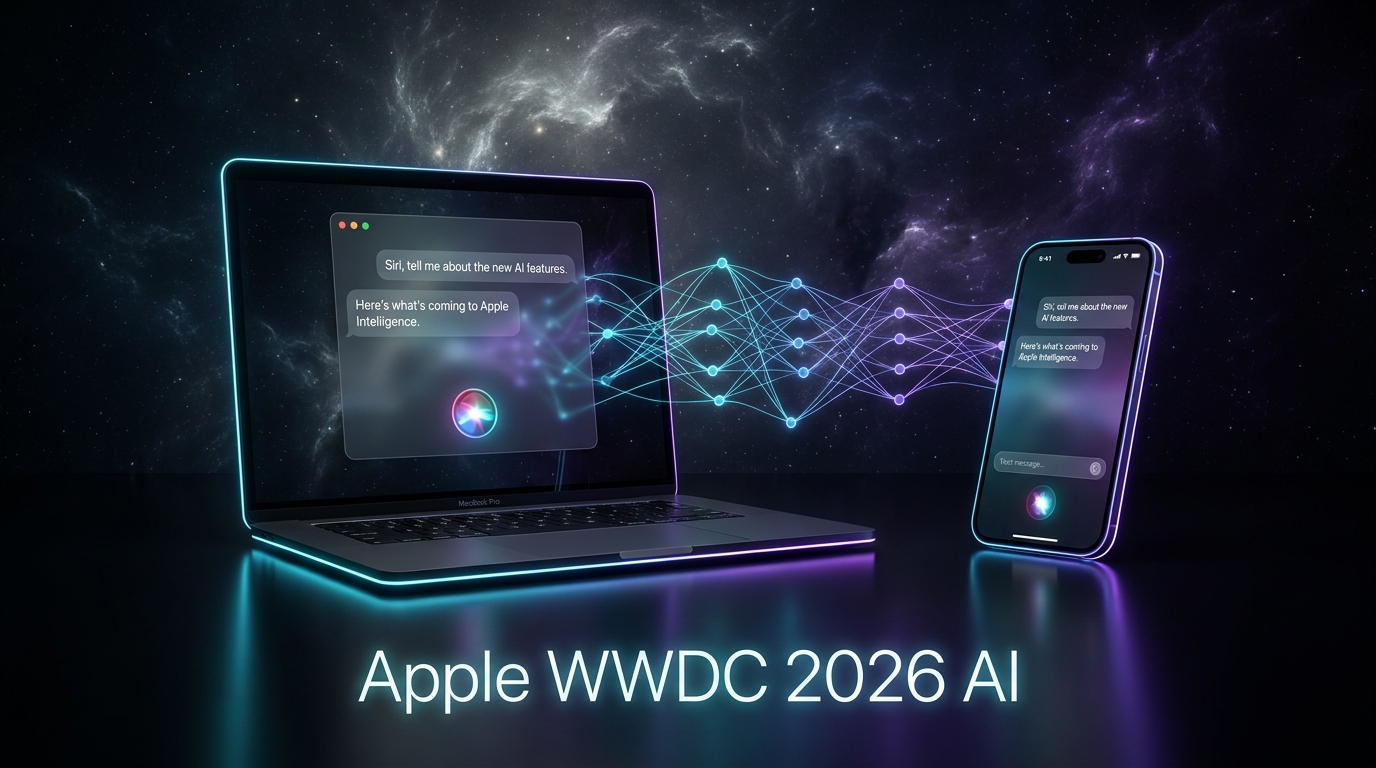
The short version: Apple held its Worldwide Developers Conference from 8 June. The headline was a completely rebuilt Siri using Google's Gemini model — conversational, context-aware, and capable of taking actions across apps. Supporting announcements included iOS 27, macOS 27, free AI access for qualifying app developers, and a new developer framework for building multi-agent AI workflows. For small businesses, the most practical changes arrive in autumn 2026 when iOS 27 ships to iPhones and iPads.
The rebuilt Siri
The new Siri can handle multi-step requests across apps, revisit previous conversation context, and take actions on your behalf — booking, drafting, searching — rather than simply retrieving information. It ships with a standalone Siri app, available on iPhone, iPad, and Mac.
The partnership with Google is notable. Apple Intelligence, which Apple has been building since 2024, uses Apple's own on-device models for privacy-sensitive tasks and routes more complex requests to cloud models. Google Gemini is the cloud partner for the most capable interactions. (Apple also maintains a partnership with OpenAI for certain tasks — this is Apple hedging across providers, not an exclusive deal.)
For small business operators, the rebuilt Siri means that the AI assistant on your existing iPhone becomes substantially more useful for business tasks: scheduling, drafting messages, researching suppliers, summarising documents. No additional app or subscription is required beyond the iOS update.
iOS 27 — the AI operating system update
Every app with standard iOS permissions can now surface suggestions, summaries, and actions through Apple's AI framework. For businesses using Apple's built-in apps — Mail, Notes, Calendar, Reminders — meaningful AI assistance arrives as part of the OS update at no additional cost.
For service businesses that rely on iOS for scheduling and customer communication, the combination of rebuilt Siri and OS-level AI could meaningfully reduce the time spent on routine administrative tasks — replying to enquiries, creating calendar entries, summarising voice notes after customer visits.
Free AI developer models for smaller apps
This means a small business that builds or commissions a custom iOS app — for customer booking, staff scheduling, or field service management — can integrate Apple AI capabilities without paying per-call API fees, as long as the app stays below the download threshold.
This is relevant if you have ever been quoted for custom business software and AI integration was cited as an additional cost. For apps built on Apple's native frameworks, that cost ceiling just dropped significantly for smaller deployments.
Multi-agent developer framework
Apple also announced a new Dynamic Profiles system in its Foundation Models framework — a toolkit for building multi-agent workflows. In plain terms: developers can now build iOS apps where different AI agents handle different steps of a business process, calling each other in sequence. This is the same architectural pattern that enterprise AI systems have been using, now available in Apple's native developer environment.
For most small businesses, this does not require any immediate action. It is a signal that the apps you rely on for business operations are likely to gain more sophisticated AI capabilities over the next 12 to 18 months, as developers build on the new framework.
What UK small businesses should do
Your Apple WWDC action list
When iOS 27 ships (autumn 2026): Update promptly and explore the new Siri for three business tasks — scheduling, message drafting, and document summarisation.
If you use Apple Mail for business: Expect AI-powered draft suggestions and thread summarisation to arrive with iOS 27. Test them before switching to a separate AI writing tool.
If you use a custom iOS app for your business: Ask your developer whether they are evaluating Apple Foundation Models — the free tier is available now for apps under two million downloads.
No iPhone update needed yet: iOS 27 is not out yet. The WWDC announcements are developer previews. The public release is expected in September 2026.
The broader signal
Apple entering the AI assistant race properly — not with the under-powered Siri of previous years but with Gemini-backed conversational capability — means that AI is now standard infrastructure across every major computing platform a UK small business might use. Microsoft 365 has Copilot. Google Workspace has Gemini. Apple's operating system has rebuilt Siri. The question is no longer whether your devices and software will have AI built in. They already do, or will by the end of 2026.
The businesses that will benefit most are not those that use the most tools — they are those that pick one or two workflows to genuinely improve with AI, measure the result, and build from there.