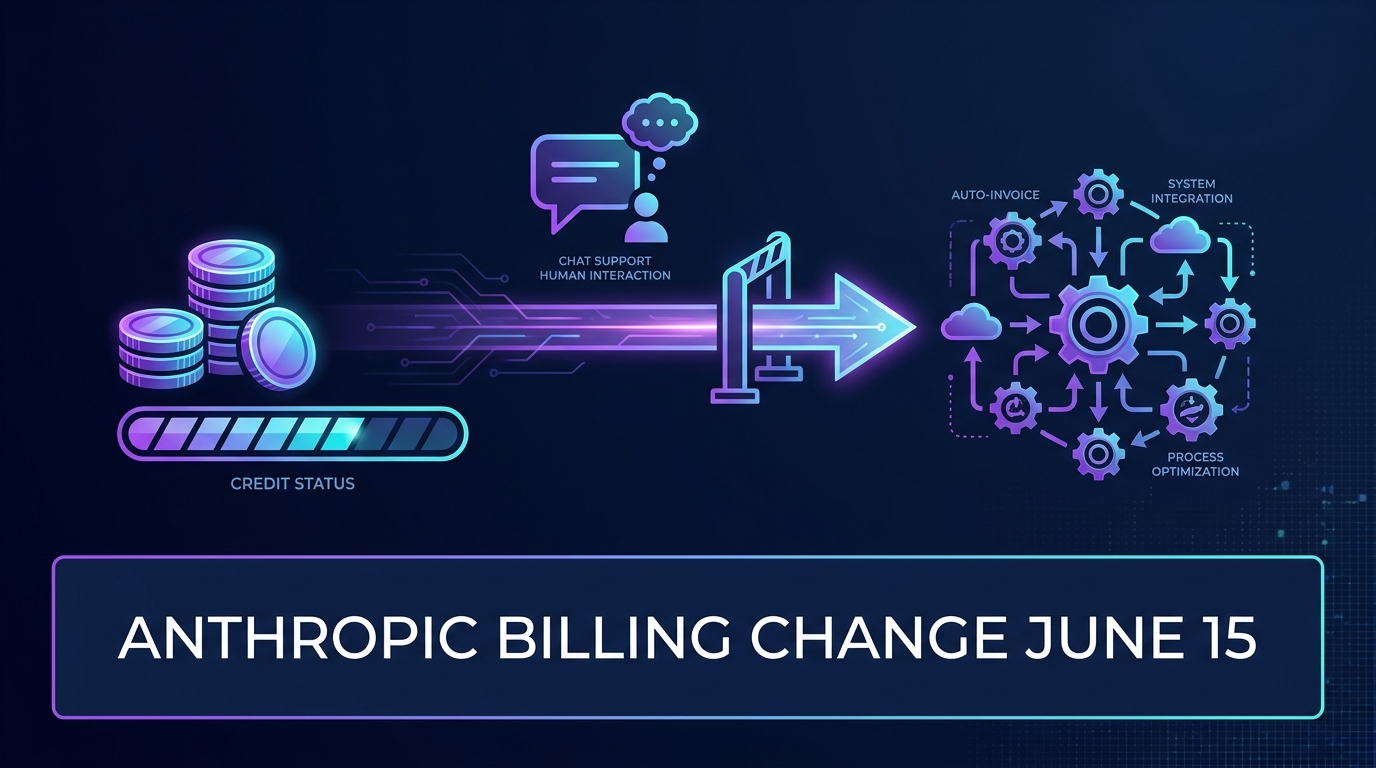
The short version: On 15 June 2026, Anthropic separates automated AI workloads from interactive Claude chat in every subscription plan. A new monthly credit replaces the previous flat-rate subsidy for Agent SDK use, Claude Code automation, and third-party AI app integrations. Interactive chat sessions are unchanged. If your business uses Claude through any automated workflow, the credit cap arrives tomorrow — and there is no automatic fallback when it runs out.
What is changing
Until now, subscribers to Pro, Max, Team, and Enterprise plans could use Claude for both interactive chat and automated workflows under one flat-rate subscription. From 15 June, automated workloads — anything running through the Agent SDK, the Claude command-line tool, Claude Code in CI pipelines, or third-party AI applications — move into a separate credit pool sized to each plan.
The credit allocation by plan:
- Pro (£17/month): £20 of monthly Agent SDK credit at API list rates
- Max 5x (£85/month): £100 of monthly Agent SDK credit
- Max 20x (£340/month): £200 of monthly Agent SDK credit
- Team and Enterprise: per-seat credit pools, specific amounts vary by contract
When the credit is exhausted, automated requests stop entirely. There is no automatic fallback and credits do not roll over to the next month. Overflow billing — paying API rates beyond the included credit — must be manually enabled by the account holder.
What is not changing
Interactive Claude.ai chat sessions and Claude Code terminal sessions used directly by a person (not in a script or automation pipeline) remain on the existing plan and are not affected by this split. If you use Claude to draft emails, research topics, or write copy in the browser, nothing changes tomorrow.
Why Anthropic is doing this
When Claude subscriptions launched, the primary use case was interactive chat. As businesses began running scheduled tasks, customer service automations, and CI/CD pipelines through the same subscriptions, the economics shifted. Anthropic is effectively separating personal productivity use (flat rate) from business-process automation (usage-based credit).
This mirrors how other infrastructure providers have handled a similar transition. Interactive tools are often priced as subscriptions. Automated, programmatic use tends to move towards consumption-based billing over time — because the volume and variability of automated use is fundamentally different from human-paced interactive sessions.
For businesses, this is a signal worth reading carefully: Anthropic is treating AI automation as a distinct category of service, not an add-on to a productivity subscription.
Who is most affected
The businesses most likely to hit the credit limit immediately are:
- Teams using Claude for scheduled automated tasks — daily reports, email triage, CRM updates running through the Agent SDK
- Developers using Claude Code in CI/CD pipelines — automated code review, test generation, or deployment scripts
- Businesses using third-party apps powered by Claude — tools like OpenClaw, Conductor, or Zed that run Claude automation in the background
- Shared team accounts — where multiple people's automation runs under one set of credentials. Credits apply per user, not per team.
Small businesses using Claude only for manual tasks — writing, research, responding to queries — are unaffected.
What to do today
If you are unsure whether your Claude usage includes automated workflows, the safest step is to check your current Claude subscription usage in the account settings before midnight tonight. Anthropic will show Agent SDK usage separately from interactive chat from 15 June.
Your June 15 billing checklist
Check: Does your business use Claude through any app, script, or automation tool (not just the browser)? If yes, identify which plan you are on and what credit you get.
Decide: Is £20/month enough for your automated Claude use, or do you need to enable overflow billing?
Enable (if needed): Turn on overflow billing in Claude account settings before your next automated run.
Long term: Start separating your manual Claude spend from your automation spend — they are now different cost lines.
The broader signal for UK small business
This billing change is not just an operational footnote. It is a signal that AI automation is maturing into a real cost centre, not a subscription bolt-on. The businesses that will build durable AI-powered operations are the ones that understand exactly what their automation is doing, how often, and at what cost.
If you are not yet running any Claude automation, this change does not affect you today. But it is a useful prompt to start planning: as AI tools move from flat-rate subscriptions to usage-based models, the businesses that have clear automation strategies will be better placed to manage those costs than those running ad-hoc workflows without measurement.
AIFA's AI Systems Snapshot is designed to help owner-operated businesses identify exactly which processes are candidates for AI automation — and build a realistic cost model before committing to a platform. If you would like one for your business, the link is below.