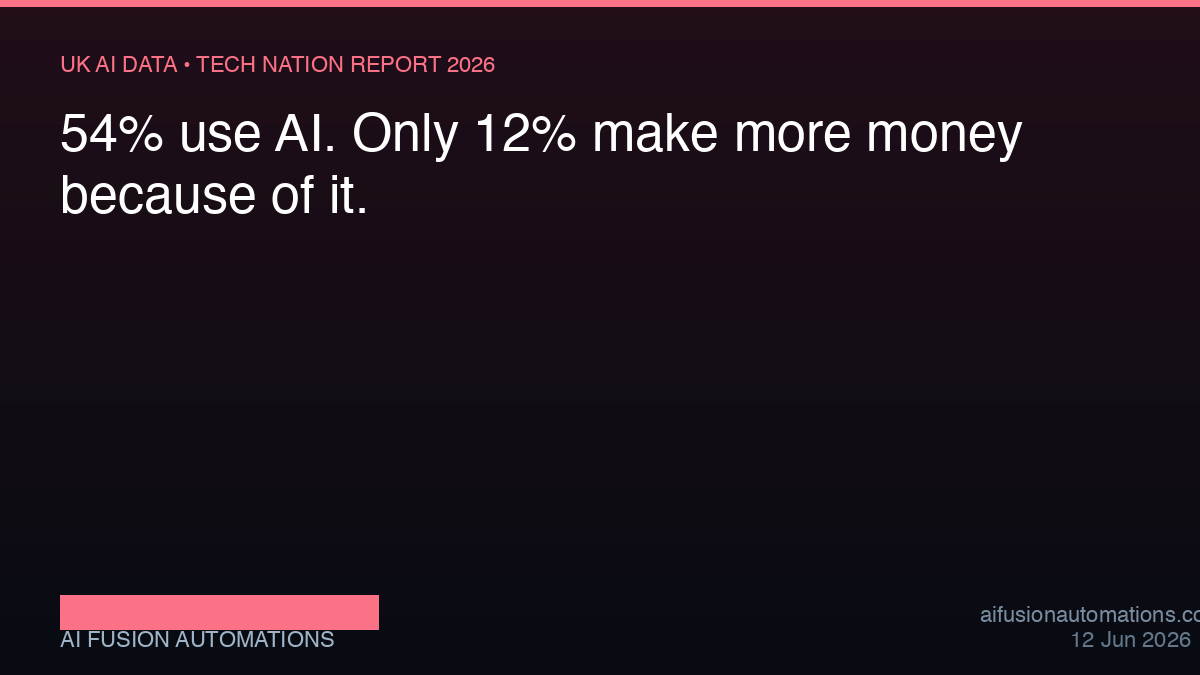
The numbers: 54% of UK firms are now actively using AI, according to British Chambers of Commerce research cited in the Tech Nation Report 2026 — launched at London Tech Week on 8 June. Government research found that productivity gains from AI are common. Revenue gains are not. Only 12% of AI-adopting UK businesses report higher revenue as a result. That gap is the story.
Why the gap exists
Productivity and revenue are not the same thing. Productivity measures how efficiently you do what you already do. Revenue measures whether more money is coming in.
AI tools are extraordinarily good at efficiency: writing faster, summarising information, answering routine questions, formatting documents, sorting emails. Businesses that adopt AI for these tasks genuinely do save time — the 20% productivity estimate from Google-commissioned research is credible. Most businesses doing the same volume of work will do it in less time.
But saving time does not automatically produce revenue. Revenue improves only when you reinvest the time you save into work that wins or keeps customers. If a business owner saves two hours a week because AI is handling their email drafts — but those two hours go into administration, scrolling LinkedIn, or simply finishing the working day earlier — the revenue stays flat.
This is not an AI problem. It is a deployment problem. And it is the exact gap that separates businesses that "use AI tools" from businesses that have an AI operating system — a structured approach to what the saved time goes into.
Where the 12% are different
The 12% reporting revenue gains share a common pattern. They have not just added AI tools to their existing workflow. They have reorganised around what AI enables — specifically, they have identified the highest-value activities in their business (customer acquisition, retention, upsell) and deliberately routed the time saved by AI toward those activities.
For a service business, this might look like:
- AI drafts customer follow-up emails. The owner uses the saved time for outbound calls instead of typing.
- AI summarises review feedback. The owner uses the insight to improve service descriptions that convert enquiries faster.
- AI handles enquiry responses at 10pm. The owner captures leads they would previously have lost overnight.
In each case, the AI creates time or captures revenue that was previously lost. The efficiency gain is immediately connected to an income outcome.
The most common mistake
The most common mistake in AI adoption for small businesses is selecting tools by feature list rather than by business outcome. A business owner reads that AI can "save time on emails," downloads a tool, saves time on emails, and notices no difference in revenue — because the emails were not the bottleneck.
The right question is not "what can AI do?" It is "which specific friction in my business is costing me customers or income?" Then: "is there an AI tool that removes exactly that friction, and nothing else?"
This is a process question before it is a technology question. It is also why the 54%/12% gap exists: most businesses adopted AI tools before they had answered the process question.
What to do with this data
The Tech Nation Report 2026 data is a useful benchmark for small business owners who are uncertain whether AI is "working" for them. If you are using AI and saving time but not seeing income grow, you are in the majority — and the fix is available.
Start with one question: where in your business does a customer interaction most often fail to convert to a booking, sale, or repeat purchase? That is where AI intervention has the clearest revenue path. Document the specific friction, find the narrowest AI tool that removes it, and track whether that specific outcome improves over four weeks.
Your action from this data
Write down: The one customer interaction in your business most likely to be lost without AI follow-up or attention.
Find the tool: The narrowest AI tool that improves that specific interaction (not the most feature-rich one).
Measure over 4 weeks: Conversion rate, response speed, or repeat booking rate — one metric, not five.
This is the move from the 54% to the 12%.