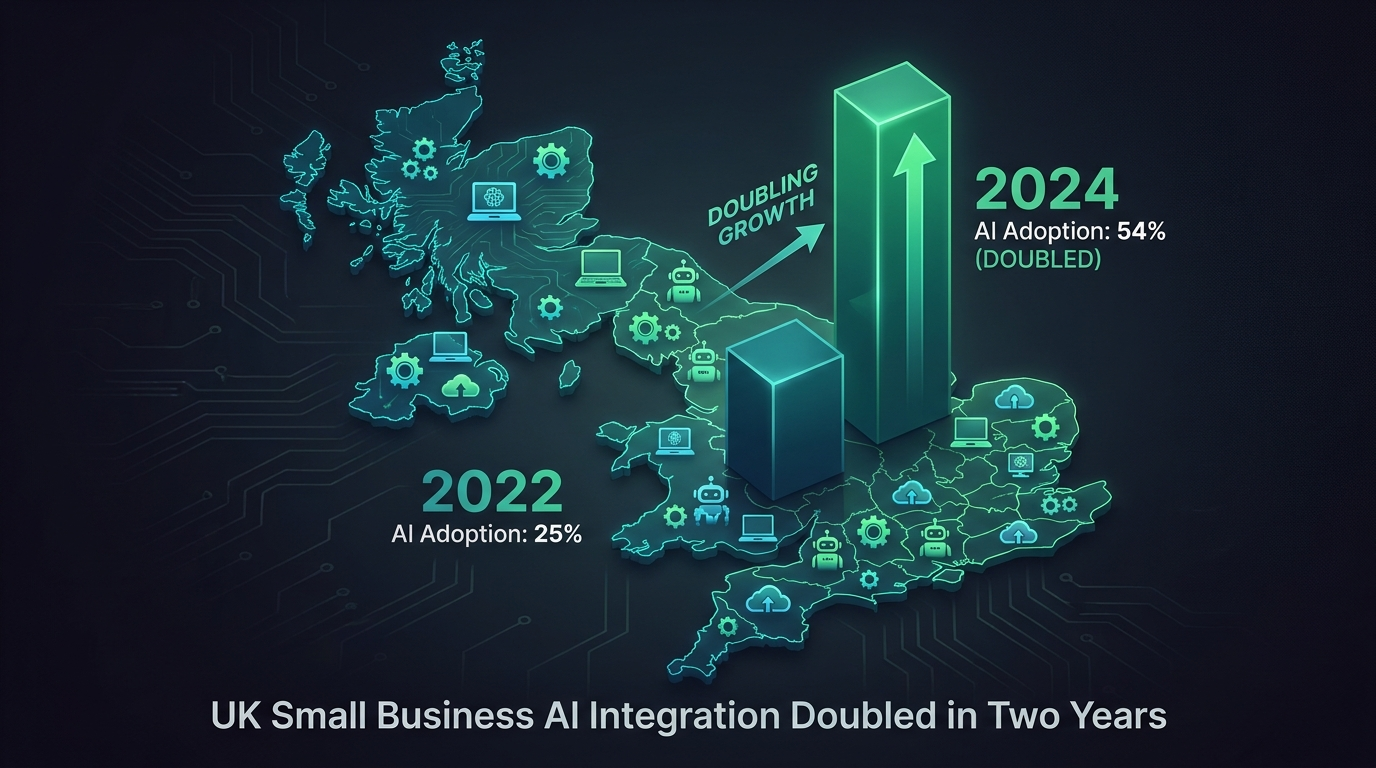
The short version: The British Chambers of Commerce confirmed that 54% of UK SMEs are now using AI tools — more than double the 25% recorded in 2024. For every service business operator still watching, this is now a competitive benchmark, not a technology curiosity. The businesses on the other side of this number are pulling ahead.
What the data shows
The British Chambers of Commerce published a report in April 2026 — "Powering Productivity: AI and the Future of UK Work" — tracking AI adoption and employment impact across the UK SME sector. The headline finding: 54% of UK SMEs now use AI tools, up from 25% in 2024. That is not incremental growth. It is a doubling of the adopter base in under two years.
The deeper data is where the competitive picture sharpens. Among firms with bespoke AI integration — meaning they are not just using an off-the-shelf chatbot but have built AI into their actual workflows — approximately one in five reports staffing reductions directly attributable to AI. These businesses are also around three times more likely to have formally restructured job roles.
Entry-level work is bearing the sharpest impact. Graduate hiring is down 45% year on year among AI-adopting firms. Youth unemployment is forecast to reach 17% this year, partly because document drafting, basic analysis, data entry, customer interaction, and inbox routing — the tasks typically given to junior staff — are increasingly handled by AI systems running at a fraction of the cost.
What this means for service businesses specifically
The service sector is not a special case — it is the central case. Trades, consultancies, agencies, professional services, local businesses: these are where AI adoption has real and immediate leverage on costs, capacity, and customer experience. And the BCC data shows that the sector has moved. More than half of your market has crossed the line.
The businesses at 25% adoption in 2024 that are now at 54% have not been handed anything. They made decisions, took time to implement, worked through the messiness, and now operate with lower administrative load, faster response times, and better margin than they did two years ago. The distance between them and the 46% still waiting has been compounding the whole time.
The BCC report also flags that the hesitant segment tends to cite uncertainty about which tools to use, fear of disruption, and lack of a clear plan. These are solvable problems — not structural barriers. The gap is one of decision and execution, not resources or technology availability.
The employment signal for small employers
For business owners who employ staff, the data is a planning input. If you currently employ someone primarily to manage inbox routing, produce standard documents, handle data entry, or answer frequently-asked questions — the competitive businesses in your market have already reduced their dependency on those roles. The cost pressure that creates is real, even if you have not felt it yet.
This is not a call to reduce headcount. It is a call to understand the structural change that is already underway in your market and to make the choice consciously, rather than discovering later that you had paid for a workflow that your competitors automated two years ago.
Operator move for this week
Take the BCC benchmark seriously: 54% is now the floor, not the ceiling. Identify one routine task in your business that costs more than two hours per week across your team — customer enquiry responses, booking confirmations, quote follow-up, or report generation. That is your first AI target. If you are unsure where to start, that is exactly what a strategy call is for.